


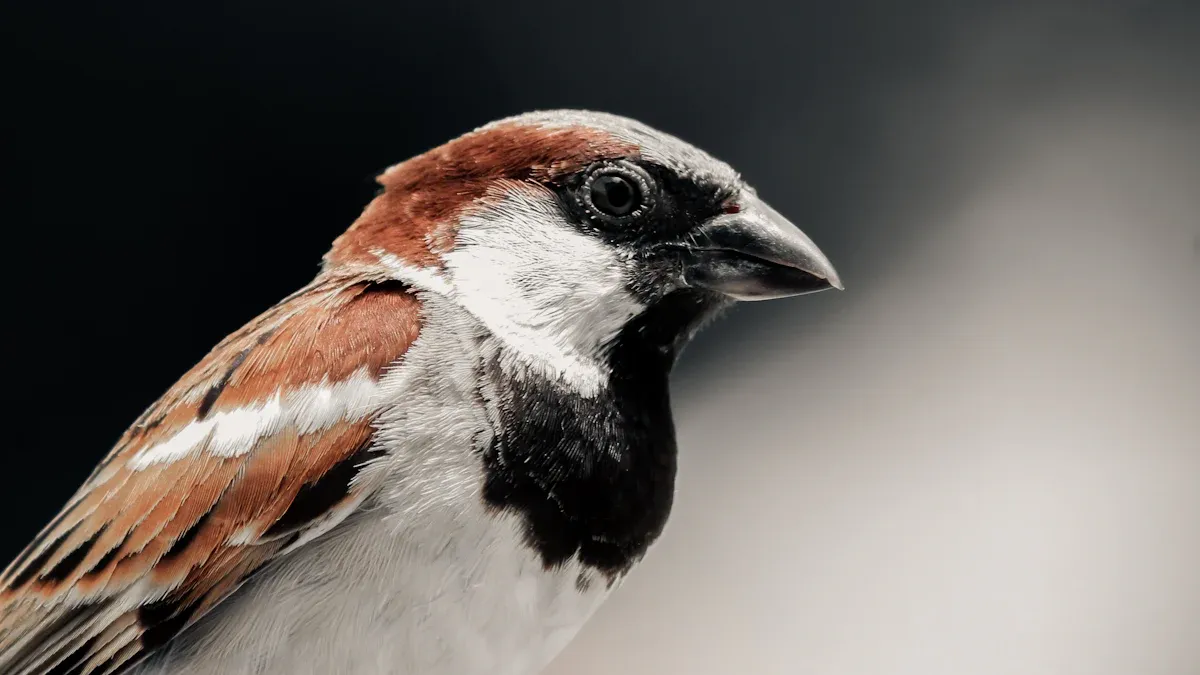
Identifying sparrows can be tricky. Many sparrows, over 60 species, share similar shapes and subtle markings. This makes distinguishing between them a real challenge. This comprehensive sparrow identification chart simplifies the process for you. You will confidently distinguish between 12 key types of sparrows. We focus on unique features, habitats, and calls of common sparrows. This guide makes identifying sparrows more rewarding for all birdwatchers.
Key Takeaways
Sparrows can be hard to identify because many look similar. They are often small and brown with streaked backs.
Look at specific features to identify sparrows. Check their head markings, breast patterns, beak shape, and tail.
Where a sparrow lives and what it does helps identify it. Observe its habitat and behavior, like how it forages.
Listen to sparrow calls and songs. Each sparrow species has unique sounds that help you tell them apart.
Practice and patience make sparrow identification easier. Use binoculars and field guides to help you learn.
Sparrow Identification Basics
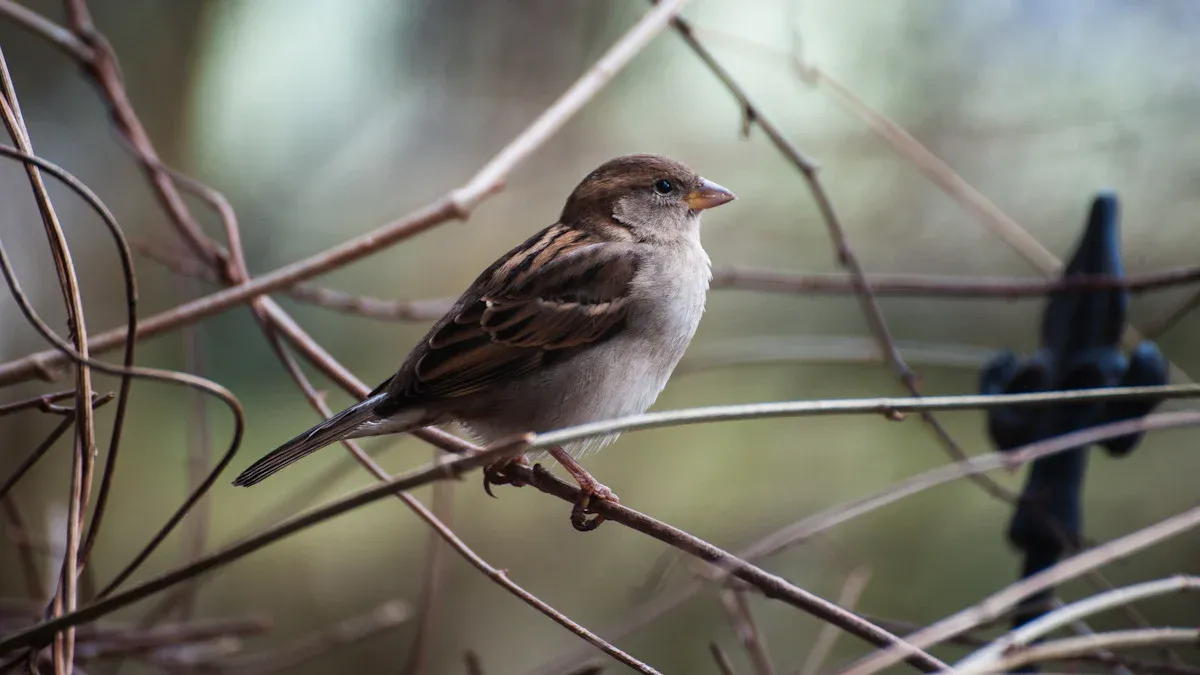
Why Sparrows Are Tricky to Identify
Identifying sparrows is a challenge for many birdwatchers. You might find yourself wondering how to tell one from another. Kevin McGowan, an instructor from the Cornell Lab of Ornithology, explains the difficulty. He says, “There is no magic bullet for sparrow identification. You have to be ready to use everything in your bird identification toolkit, and you have to learn it sparrow by sparrow.”
Here are some common reasons why sparrows can be hard to identify:
Most sparrows are small and brown.
Many species have streaked backs.
Bright colors and bold patterns are rare among sparrows.
These similarities make distinguishing between different sparrows a real puzzle.
Key Features for Sparrow ID
You can identify sparrows by focusing on specific details. Look closely at their plumage, size, and beak. These features provide crucial clues.
Feature Category | What to Look For | Examples |
|---|---|---|
Head Markings | Crown stripes, eye-lines, eyebrow stripes, malar stripes (stripes from the beak down the cheek) | White crown stripe, rufous crown, black eye stripe |
Breast/Body | Streaking patterns, central breast spots, plainness | Heavily streaked breast, unmarked pale breast, black heart spot |
Beak Shape | Color and form of the bill | Stout conical bill (seed-eaters), pink bill, bicolored bill |
Tail | Length, color, and any unique markings | White outer tail feathers (visible in flight), short tail, long tail |
For example, some sparrows have a clear white eyebrow. Others show a distinct black throat. Pay attention to these small differences.
Habitat and Behavior Clues
Where you find sparrows and what they do offers important clues for identifying sparrows. Their environment and actions can narrow down the possibilities.
Observe their preferred habitat. Some sparrows prefer open grasslands. Others live in dense shrubs, forest edges, or even urban areas. For instance, you might find certain sparrows foraging in fields. Other sparrows might prefer your backyard feeder.
Watch their behavior. Do they forage on the ground by kicking leaves? Do they perch high on fences or low in bushes? Do they pump their tails when they fly or land? These actions help you distinguish between different sparrows.
| Species | Scientific Name | Size (Length) | Male Appearance | Female Appearance | Distinctive Markings / Field ID Tips | Habitat | Song / Call | Range |
|---|---|---|---|---|---|---|---|---|
| House Sparrow | Passer domesticus | 14–16 cm (5.5–6.3 in) | Gray crown, chestnut nape, black bib, white cheeks | Dull brown overall, streaked back, pale eyebrow | Males have black bib; females lack it. Chunky bill. Often near humans. | Urban areas, farms, gardens | “Cheep-cheep” chirps | Global (introduced widely) |
| Eurasian Tree Sparrow | Passer montanus | 12–14 cm (4.7–5.5 in) | Chestnut crown, black cheek spot, white collar | Similar to male | Black cheek spot (key difference from House Sparrow) | Wood edges, farmland, rural towns | “Tchip” or “tseeu” | Europe to Asia; parts of SE Asia |
| Song Sparrow | Melospiza melodia | 12–17 cm (4.7–6.7 in) | Streaked brown, dark central breast spot | Same as male | Streaky chest with dark center spot; long tail | Brushy fields, marshes | Complex, musical “maids-maids-maids put on your tea-kettle-ettle-ettle” | North America |
| Chipping Sparrow | Spizella passerina | 12–14 cm (4.7–5.5 in) | Rusty crown, black eye line, gray underside | Duller with brown crown | Clear gray belly, distinct rusty crown | Open woods, lawns | High, dry “trrrrrr” trill | North America |
| White-crowned Sparrow | Zonotrichia leucophrys | 15–17 cm (5.9–6.7 in) | Bold black and white crown stripes | Similar, duller | Pink bill, gray face, clean breast | Shrubby tundra, gardens | Clear whistles: “Oh sweet Canada-Canada-Canada” | North America |
| White-throated Sparrow | Zonotrichia albicollis | 15–17 cm (5.9–6.7 in) | White throat patch, yellow lores | Similar | Two color morphs (white-striped, tan-striped) | Forest edges, brushy areas | Whistled “Oh sweet Canada, Canada” | Eastern North America |
| Savannah Sparrow | Passerculus sandwichensis | 12–15 cm (4.7–5.9 in) | Streaky breast, yellow above eye | Same | Short tail, fine streaks, yellow eyebrow | Grasslands, coastal meadows | Short, buzzy “tsip-tsip-trrrrr” | North America |
| Fox Sparrow | Passerella iliaca | 15–19 cm (5.9–7.5 in) | Reddish (rufous) upperparts, heavily spotted chest | Same | Large, bold spots; gray face pattern | Forest undergrowth | Rich whistled song, thrush-like | North America |
| House Finch (compare) | Haemorhous mexicanus | 13–15 cm (5.1–5.9 in) | Red head and chest, brown streaking | Brown-streaked | Curved bill, red wash on male | Urban/suburban areas | Long warbling song | North America (introduced eastward) |
12 Key Types of Sparrow Birds: An Identification Chart
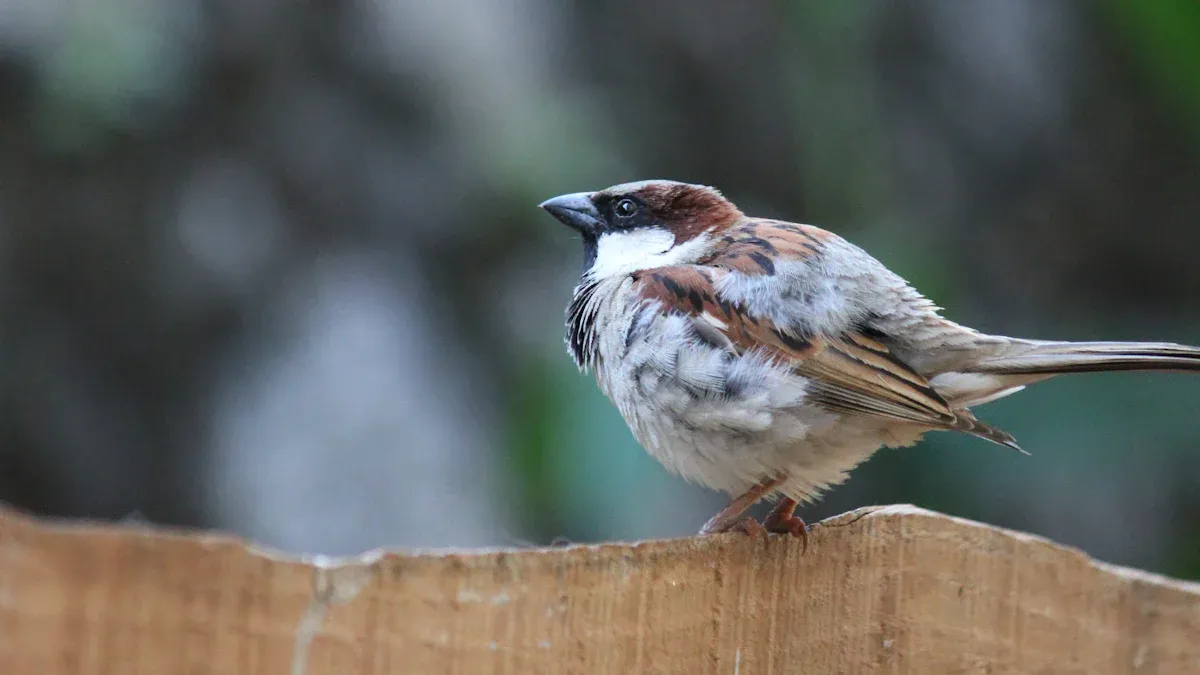
You can learn to identify many types of sparrow birds. This sparrow identification chart helps you recognize 12 common sparrows. You will discover their unique features, preferred homes, and sounds.
House Sparrow
House Sparrows are common sparrows you often see in towns and cities. They are not native sparrows in North America.
Plumage/Markings: Male House Sparrows have a gray cap, a chestnut-brown nape, white cheeks, and a black bib on their throat. Their backs and wings are brown with black streaks. Female House Sparrows look duller. They have plain buffy-brown bodies and streaked backs. They lack the bold markings of the males. Young House Sparrows look like females but are paler.
Size/Shape: These sparrows are chunky with a round head, a stout bill, and a short tail.
Beak Shape: They have a stout, conical bill.
Habitat: You typically find House Sparrows in places changed by humans. This includes villages, towns, and cities. They build nests in holes in buildings and in nest boxes.
Call/Song: They make a series of chirps and chattering sounds.
American Tree Sparrow
The American Tree Sparrow is a beautiful winter visitor in many areas. It is one of the native sparrows.
Plumage/Markings: Look for a plain grayish-white chest with a distinct dark spot in the center. They have a large reddish cap on their head. A thin, rusty-red line runs from their eye. Their wings show two thin, white horizontal stripes.
Size/Shape: They are medium-sized sparrows with a fairly long and dark tail.
Beak Shape: Their bill is two-toned. The top half is dark or gray, and the bottom half is yellowish.
Habitat: American Tree Sparrows breed near the treeline in open, scrubby areas. These areas have willows, birches, or alder thickets. In winter, you find them in open forests, fields, and gardens. They also visit residential yards with feeders.
Call/Song: They have a sweet, high-pitched, tinkling song.
Chipping Sparrow
The Chipping Sparrow is a small, neat sparrow. It is one of the native sparrows.
Plumage/Markings: This sparrow has a rusty-red cap and a black eye-line. A bright white stripe sits above its eye. Its breast and belly are plain gray. Its back and wings are brownish with two thin wing bars.
Size/Shape: Chipping Sparrows are small with a slender build.
Beak Shape: They have a small, conical black bill. This bill can be lighter during non-breeding months.
Tail Length/Movement: They have a medium-length tail.
Habitat: You often find Chipping Sparrows in suburban yards and open woodlands. They also live in parks and gardens.
Call/Song: Their song is a uniform trill. It sounds like a rapidly produced series of “tssips” on one pitch. They also make a sharp “chip” call. This call gives them their name.
Field Sparrow
The Field Sparrow is a charming bird of open country. It is one of the native sparrows.
Plumage/Markings: This sparrow has a rusty-brown back and crown. Its breast is white to light gray and unstreaked. It has a gray face with a distinct white eye-ring. Young Field Sparrows have streaking on their chest.
Size/Shape: They are small to medium-sized sparrows.
Beak Shape: They have a pinkish, conical bill.
Tail Length/Movement: Their tail is medium length.
Habitat: Field Sparrows prefer overgrown fields and shrubby areas. They like open, savanna-like habitats and forest edges. They need fields with some trees or shrubs for perches.
Call/Song: Their song is a series of clear, slurred whistles that speed up at the end.
Song Sparrow
The Song Sparrow is one of the most widespread and variable native sparrows.
Plumage/Markings: Song Sparrows are streaky brown birds. They have coarse streaks on their breast. These streaks often come together to form a central breast spot. They have russet stripes on their crown and through their eye. A broad malar or mustache stripe marks their face. Their plumage varies greatly across North America. Birds near the coast are darker and streakier. Desert birds are paler.
Size/Shape: They are medium-sized sparrows with a full body.
Beak Shape: They have a conical bill.
Tail Length/Movement: They often pump their tail when they fly or land.
Habitat: You find Song Sparrows in many habitats. These include shrubby areas, wetlands, and suburban gardens.
Call/Song: They have a rich, varied song. It starts with clear notes and ends with a buzzy trill.
White-throated Sparrow
The White-throated Sparrow is a striking and easily recognized bird. It is one of the native sparrows.
Plumage/Markings: This sparrow has bold black and white crown stripes. A yellow spot sits between its eye and bill. It has a distinct white throat patch against a gray face and breast. Its upperparts are reddish-brown with dark streaks. Its underparts are grayish. Some White-throated Sparrows have tan and brown head stripes instead of black and white. Young birds have brown-and-black head stripes and faint breast streaks.
Size/Shape: It is a large, plump sparrow with a rounded head and long legs. It has a long, narrow tail.
Beak Shape: It has a small, grayish bill.
Tail Length/Movement: Its tail is long and narrow.
Habitat: You find them in forests, woodlands, and suburban areas. They often forage on the ground.
Call/Song: Its characteristic song is a series of high-pitched whistles. Many people describe it as “Oh sweet Canada, Canada, Canada.” They also make a distinct “seep” call.
White-crowned Sparrow
The White-crowned Sparrow is a handsome bird with a distinctive head pattern. It is one of the native sparrows.
Plumage/Markings: Adults have a striking black and white striped crown. This crown sits against a gray background. Young birds have more subdued tan head stripes. Their head feathers often raise slightly at the back. This gives them a square-headed look. Their breast is plain gray.
Size/Shape: They are medium-sized sparrows.
Beak Shape: They have a conical bill.
Tail Length/Movement: They have a medium-length tail.
Habitat: You often see White-crowned Sparrows foraging on the ground. They prefer open areas near brushy habitats. They also visit bird feeders.
Call/Song: Their song is a clear, whistled phrase followed by a buzzy trill.
Fox Sparrow
The Fox Sparrow is a large, robust sparrow. It is one of the native sparrows.
Plumage/Markings: Fox Sparrows are large and rusty-red. They have heavily streaked breasts. These streaks often form a central spot. Their overall color varies greatly. Eastern birds are very reddish. Western birds are mostly gray with some reddish. Pacific Northwest birds are dark sooty brown. They have a long tail and a two-toned bill.
Size/Shape: They are large, chunky sparrows.
Beak Shape: They have a bi-colored dark and pale yellow bill. Some California birds have very large bills.
Tail Length/Movement: They have a long, rusty-red tail. They often kick leaves vigorously when foraging.
Habitat: Fox Sparrows prefer dense thickets and forest floors. They also live in shrubby areas.
Call/Song: Their song is a series of rich, clear whistles.
Savannah Sparrow
The Savannah Sparrow is a streaky bird of open country. It is one of the native sparrows.
Plumage/Markings: This sparrow has a distinctive yellow spot before its eye. Its back is brown and streaked. Its underparts are white and streaked. It has a heavily streaked breast without a central spot.
Size/Shape: They are small sparrows with a short, notched tail and a small head.
Beak Shape: They have a conical, pinkish bill.
Tail Length/Movement: Their tail is short.
Habitat: Savannah Sparrows prefer open grasslands and salt marshes. You also find them in fields, roadsides, and farmlands.
Call/Song: Their song is a series of thin, high-pitched notes followed by a buzzy trill.
Vesper Sparrow
The Vesper Sparrow is a ground-dwelling bird. It is one of the native sparrows.
Plumage/Markings: This sparrow has a rusty shoulder patch. Its breast is streaky. A key feature is its prominent white outer tail feathers. You see these feathers when the bird flies.
Size/Shape: They are medium-sized sparrows.
Beak Shape: They have a conical bill.
Tail Length/Movement: Their white outer tail feathers flash during flight.
Habitat: Vesper Sparrows prefer open fields, pastures, and dry grasslands. They often perch on fences or low shrubs.
Call/Song: Their song is a series of clear, whistled notes.
Dark-eyed Junco
The Dark-eyed Junco is a common winter bird in many areas. Many people mistake it for a sparrow. It is one of the native sparrows.
Plumage/Markings: Dark-eyed Juncos are dark gray or brown birds. They have a white belly. Their white outer tail feathers flash in flight. Males of the Slate-colored Junco (eastern U.S.) have handsome gray and white plumage. Females have lighter coloring with more brown shades.
Size/Shape: They are medium-sized with a rounded head and a stout bill.
Beak Shape: They have a soft pink bill.
Tail Length/Movement: Their long tail shows white outer feathers when they fly. They often spread their tail during dominance or courtship displays.
Habitat: You find them in forests, woodlands, and suburban areas. They often feed on the ground, scratching snow or leaves for seeds.
Call/Song: They make a ringing metallic trill. They also use “tsick” or “tchet” calls to keep contact in flocks.
Eurasian Tree Sparrow
The Eurasian Tree Sparrow is a localized bird in North America. It is not one of the native sparrows.
Plumage/Markings: This sparrow has a chestnut crown. It has a black cheek patch and a black bib. It is smaller and more elegant than the House Sparrow. Males and females look the same.
Size/Shape: They are smaller than House Sparrows.
Beak Shape: They have a conical bill.
Tail Length/Movement: They have a medium-length tail.
Habitat: In North America, you find Eurasian Tree Sparrows mainly around St. Louis, Missouri. They live in parks, farms, and rural woods. They avoid urban areas due to competition with House Sparrows.
Call/Song: They make a sharp, metallic “chip” call.
Advanced Sparrow Identification Tips
You can improve your sparrow identification skills. Use these practical tips and techniques.
Using Binoculars and Field Guides
Binoculars are essential tools. You can practice a “quick draw” with your binoculars. Aim at distant objects like trees. Focus quickly. This improves your speed and accuracy in finding birds. Practice bringing binoculars to your eyes. Look at a large object. Note how far off you are. This builds muscle memory for quick targeting.
Reduce the target size to fine-tune this skill for bird-sized targets. Adjust the diopter eyepiece, usually on the right side. This matches your eyesight. It prevents eye strain. Start with lower magnification binoculars, like 7x. This gives you a wider field of view. It helps you spot a bird when you are learning to aim. Lower magnification also reduces body shake. Use stable objects like walls to steady your binoculars. Practice using your binoculars consistently. This makes you efficient when you see a bird you want to identify.
Listening to Calls and Songs
Listening to calls helps you identify sparrows. Many sparrows have distinct calls. Both male and female Chipping Sparrows use a single “chip” note. They use it all year to stay in contact. When a hawk appears, Chipping Sparrows make a long “zeeee” call. This is an alarm. During courtship, female Chipping Sparrows make a soft, rapid “see-see-see-see” sound. This attracts their mate. These specific sounds help you identify sparrows.
Observing Behavior and Habitat
Observe sparrow behavior. This gives you important clues. Many sparrows forage on the ground. Chipping Sparrows peck through leaf litter. They do this at the edge of wooded areas. When you approach them, these sparrows often fly a short distance. They land again further along the path. They do not scatter into trees. This repeated flight pattern helps you identify them.
Sparrows to Look For During Migration
Migration periods offer chances to see different sparrows. Recent studies show the Golden-crowned Sparrow’s migration. Researchers use geolocators to track them. This helps us understand their breeding and migration. The House Sparrow is a permanent resident. You find it across North America all year. Knowing which sparrows to look for during migration helps your birdwatching.
Photography for ID Confirmation
Take photos of sparrows. This helps you confirm their identity. You can zoom in on details later. This allows you to study markings. You can compare them with field guides. This is especially useful for tricky sparrows.
Sparrow identification can seem difficult. You will find it manageable and enjoyable with practice. Pay attention to details. You can identify sparrows by focusing on specific markings. Understand their habitat preferences. Recognize their unique behaviors and calls. Use this sparrow identification chart as a practical tool. It will help you on your birdwatching adventures. You will feel great satisfaction when you accurately identify these common sparrows. Enjoy learning about these diverse sparrows!