


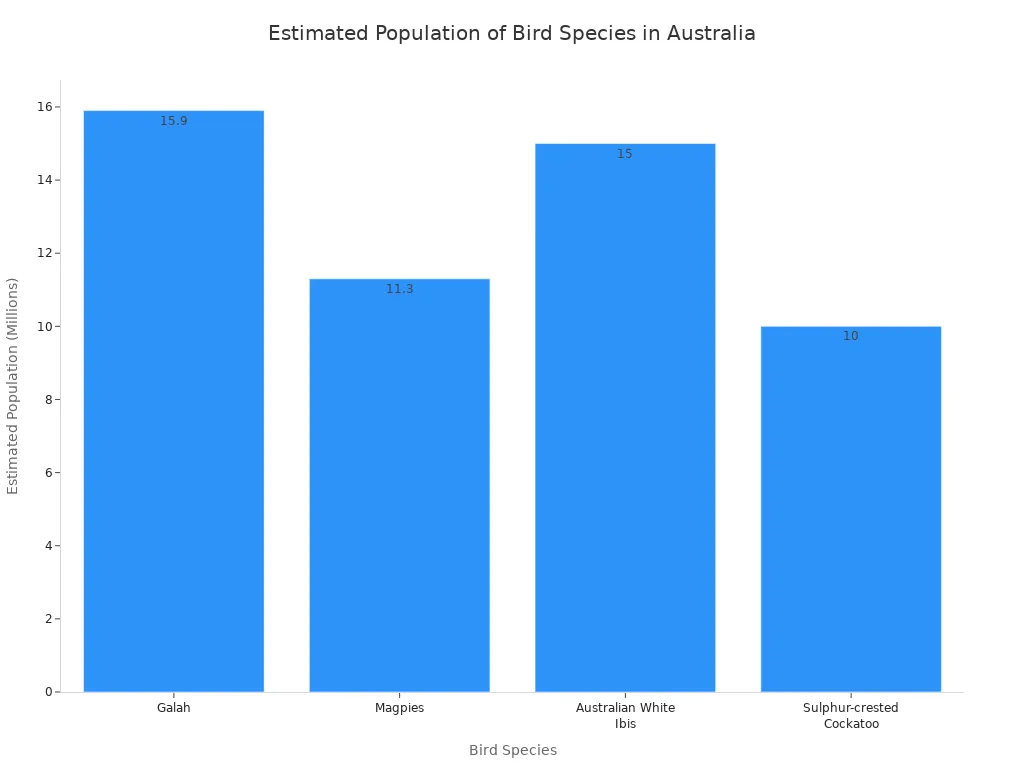
Australia’s landscapes often showcase stunning black and white birds. These captivating birds are a common sight across the continent, with many beautiful birds filling the skies. Many bird populations thrive here. For example, the australian magpie alone has an estimated population of 11.3 million birds. This common magpie is just one of many black and white birds.
People often confuse similar-looking birds like the australian magpie, magpie-lark, and fantail. Knowing how to identify each bird provides a deeper connection with local wildlife. This identification guide helps readers distinguish these fascinating bird species.
Key Takeaways
Bird identification helps you connect with nature. It also helps scientists study birds and understand ecosystems.
Look at a bird’s feathers, size, beak, and how it moves its tail. These features help you tell different birds apart.
The Australian Magpie is a large bird with a white patch on its neck. The Magpie-lark is smaller and bobs its head when it walks.
The Willie Wagtail constantly wags its tail from side to side. It has an all-black head with a white eyebrow.
Listen to bird calls. The Australian Magpie has a warbling song. Ravens have a long, wailing call.
Why Bird Identification Matters
Bird identification offers many benefits. It connects people with nature. It also helps scientists and improves understanding of ecosystems.
Enhancing Nature Connection
Identifying birds brings significant mental and physical health benefits. Activities like birdwatching, which includes identification, provide fresh air and sunlight. This improves mood and reduces seasonal affective disorder. Observing birds also lessens feelings of depression and anxiety. It boosts positive emotions and self-esteem. Researchers find outdoor activities link to well-being and life satisfaction. Identifying a bird creates new experiences. It provides moments of awe. People learn more than just a bird’s name. They discover its calls, nests, or feeding habits. This creates new memories. The pure pleasure of seeing a bird, like the first oriole of spring, brings joy. It sparks curiosity and leads to new knowledge. This fosters a concern for the world’s birds. It encourages action for their conservation. Bird identification offers personal joy and relief from daily stress.
Citizen Science Contributions
Bird identification plays a vital role in citizen science. Many projects rely on public observations. For example, eBird allows birders to store their records. Merlin helps users identify birds globally. The Great Backyard Bird Count invites individuals to submit bird sightings. NestWatch provides guidelines for observing baby birds. Participants share data with scientists. These observations create a vast data repository. Scientists use this data to track bird populations. They study migration patterns. They also see the effects of environmental changes. Real-time data helps understand avian ecology. It identifies shifts in migration and breeding patterns. This data informs conservation efforts. It helps identify key stopover sites for migratory birds.
Understanding Ecosystems
Bird identification is crucial for understanding ecosystem health. Birds serve as indicator species. Their status gives insights into an ecosystem’s overall condition. They reflect environmental quality and community composition. Birds are valuable indicators because they are sensitive to environmental changes. They show predictable responses. People can easily observe and study them. Their rapid metabolism makes some birds sensitive to minor habitat changes. Migratory patterns reveal global environmental issues. For example, declines in Peregrine Falcons showed the dangers of DDT. The phrase “the canary in the coal mine” highlights how birds warn of danger. Birds indicate deteriorating habitat quality. They signal environmental pollution. They also measure the success of restoration efforts.
Key Identification Features
Identifying different birds becomes easier when you know what to look for. Several key features help distinguish one bird from another. These include plumage, size, beak shape, tail movements, and unique vocalizations.
Plumage and Markings
Bird identification often starts with plumage. This includes the distinct color and pattern of a bird’s feathers. Look for prominent color patches on the head, breast, and wings. Also, notice stripes, spots, or streaks. Tail feather color can also be a strong diagnostic feature. For example, the Australian Magpie has white on the back of its neck. The Pied Currawong is mostly black with clear white flashes on its wings and tail. The Magpie Lark looks like a smaller magpie. Females have a white face and throat, while males have a black face and throat. The Willie Wagtail has an entirely black head with a distinct white ‘eyebrow’. The Restless Flycatcher has a white lower half of its head, which contrasts with the Willie Wagtail’s black head. Field marks are specific visual details. These include eye-rings, pale or dark lines on the face, and wing bars. These details help when color is hard to see.
Size and Body Shape
Comparing a bird’s size to familiar species helps categorize it. Overall body shape is also a clue. For instance, the Australian Magpie has a black and white pattern and a square-tipped tail. Males have a white neck, upper tail, and shoulders. Females have grey in these areas. The Australian Pied Oystercatcher is a medium shorebird. It has long skinny legs and a long beak. It is 50 cm long from head to tail. The Black Swan has a body length of 110-140 cm. Its wingspan is 160-200 cm. It has a black body and neck with white wing tips.
Beak Structure
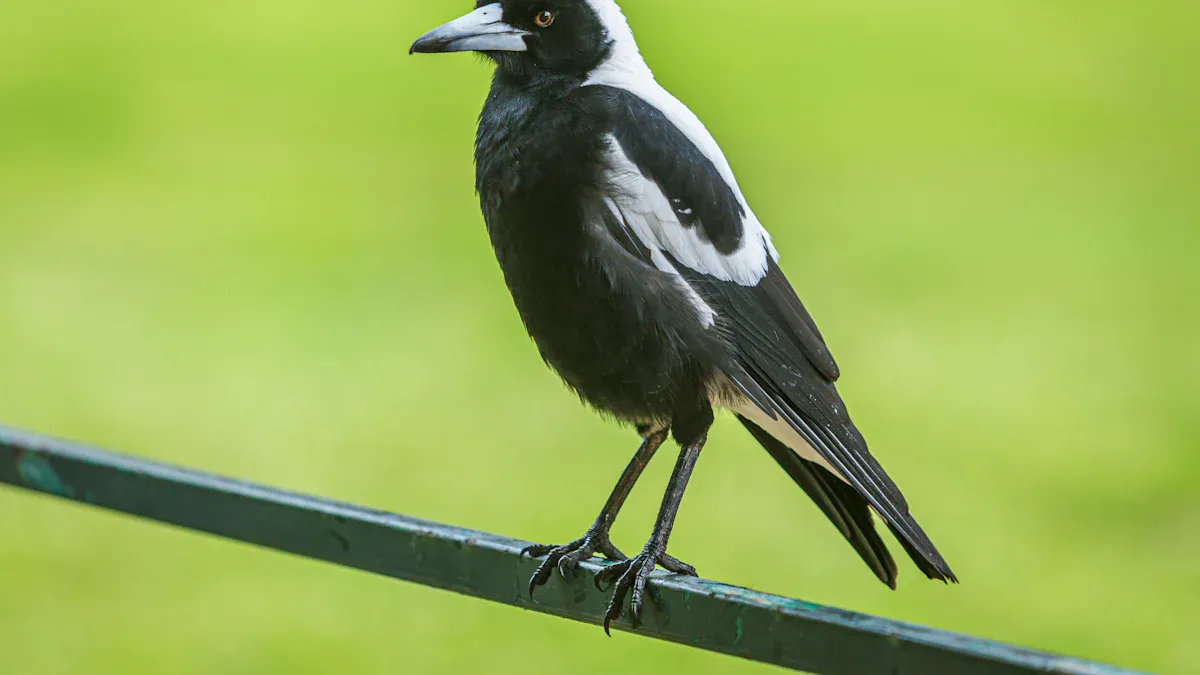
Beak shape, color, and length vary among birds. These features are important for identification. The Australian Magpie has a wedge-shaped bill. This bill is bluish-grey and tipped with black. Different birds have different beak types. Some beaks are massive for cracking nuts. Others are fine for catching insects.
Tail Movement
Tail length, shape, and characteristic movements help identify birds. The Willie Wagtail constantly sways its black body and tail from side to side. It does this even when standing still. This movement differs from other birds. They often move their tails up and down. The name ‘wagtail’ comes from this constant sideways wagging. The bird flicks its tail from side to side while perching. It also wags its tail upon landing after a short flight.
Distinctive Calls
Unique vocalizations are very important for identifying birds. The Australian Magpie is known for its warbling sound. The Willie Wagtail produces sweet, pretty sounds. People often hear these sounds at night. It also makes a harsh, scratchy call when alarmed. Listening to these calls helps identify different birds.
Common Black and White Birds
Australia hosts many fascinating black and white birds. This section details some of the most common species. Learning their unique traits helps in identification.
Australian Magpie
Appearance
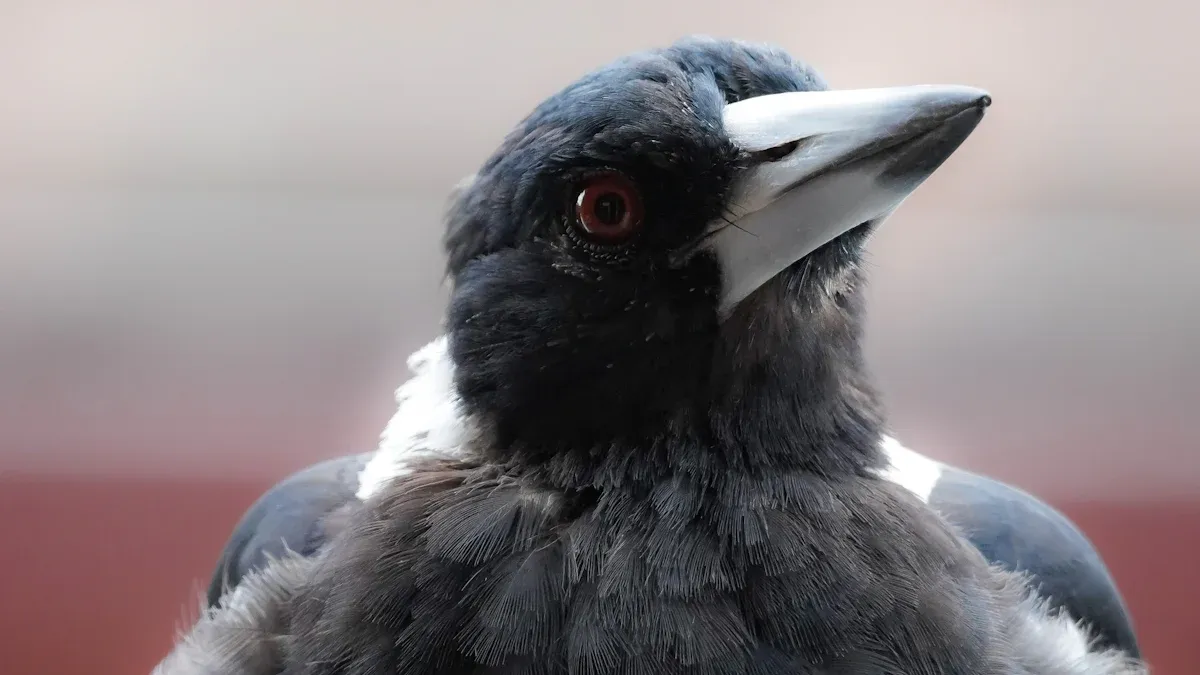
The australian magpie is a striking bird. Its plumage features bold black and white patterns. Males have a pure white nape, upper tail, and shoulders. Females show grey in these areas. This difference helps tell them apart. The australian magpie has red-brown eyes. Its beak is bluish-grey with a black tip. This bird is heavyset. It has a prominent wedge-shaped bill. The australian magpie is a familiar sight.
Habitat and Behavior
Australian magpies are very adaptable birds. They thrive in many environments. These include open areas with trees like parks and sports fields. They also live in agricultural lands and bush landscapes. Australian magpies have successfully adapted to urban settings. They are common in city parks and suburban neighborhoods. This makes them one of Australia’s most spotted birds.
The breeding season for the australian magpie runs from June to December. They build bowl-shaped nests high in tree forks. These nests use sticks and soft linings. Magpies are monogamous. They form tight social groups of up to 25 birds. Larger groups often have multiple adults helping raise young. During breeding, they become very territorial. They fiercely defend their nests. Magpies usually establish territories and breed around five years old.
Australian magpies are famous for their melodic warbling. They often mimic other birds and even car alarms. Their complex songs mark territory boundaries. These songs also help communication within groups. They use alarm calls and beak-clapping. Juvenile begging calls add to the communal chatter. Their diet is diverse. They eat earthworms, insects, spiders, and small animals like lizards. They also consume some plant matter.
Distinguishing Features
The australian magpie is larger than a magpie-lark. It has a more robust build. Its distinct white nape and shoulders (pure white in males, grey in females) set it apart. The piping shrike, a common symbol, often represents this bird. The australian magpie’s warbling call is also very unique.
Magpie-lark (Pee-wee)
Appearance
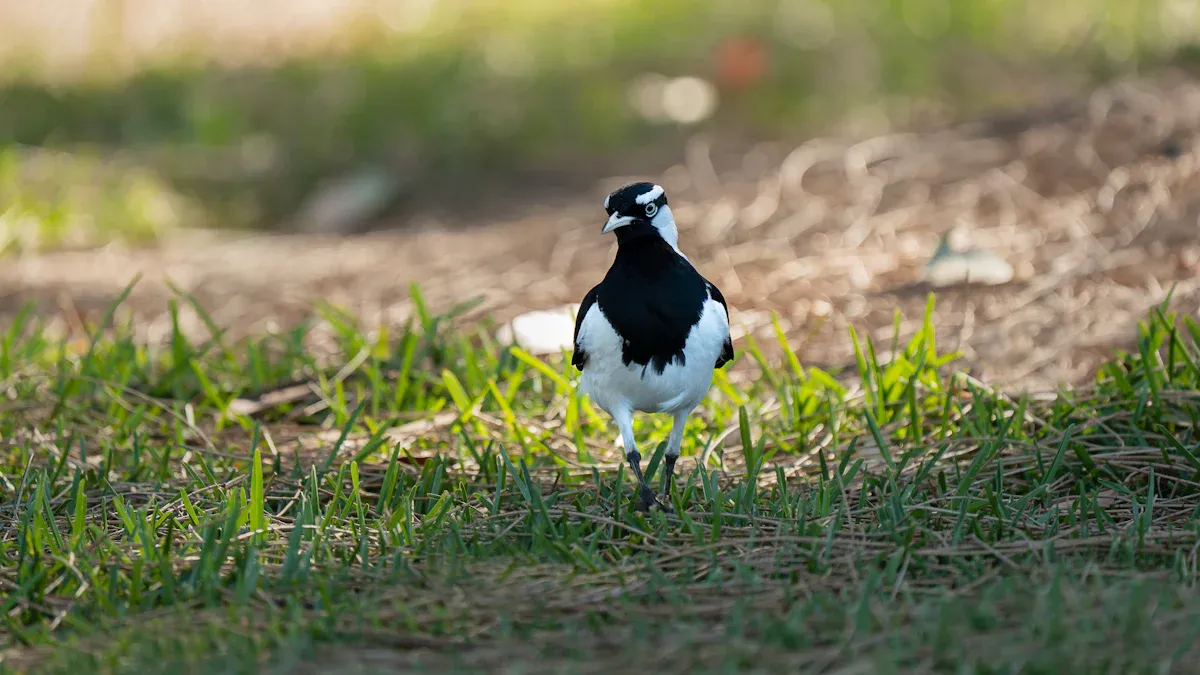
The magpie-lark is a small to medium-sized bird. It has black and white plumage. It resembles a miniature magpie. Adult magpie-larks are 25 to 30 centimeters long. This makes them noticeably smaller than the australian magpie. The adult male has a black throat and a black stripe through its eye. It has a white belly and a black back. The adult female has a white throat. She has a vertical black stripe through her eye. She also has a white belly and a black back. Both male and female juveniles have white throats and bellies. They also have broad white eyebrows. The magpie-lark has a thin, whitish bill and pale eyes. A distinctive feature is its head movement. Its head moves forwards and backwards in sync with its feet when it walks. This bird is sometimes called a mudlark due to its nest-building habits.
Habitat and Behavior
Magpie-larks are very adaptable birds. They thrive in many habitats across Australia. They are common in both urban and rural settings. They have adapted well to human presence. Their habitat needs are simple. They require soft, bare ground for foraging. They need a supply of mud for nest building. A tree for nesting is also essential. They have benefited from agricultural development. This includes forest clearing and water provision in dry areas.
Magpie-larks are primarily carnivorous. They feed on small creatures. They form loose groups of dozens of individuals. This is common in productive agricultural areas. They are aggressively territorial. They defend their space against larger birds and even humans. This is especially true when nesting. Magpie-larks typically pair for life. They sing cooperative duets to defend their territory. They respond more strongly to calls from unfamiliar birds.
Distinguishing Features
The magpie-lark is much smaller than the australian magpie. Its bill is thinner. The facial markings are key for identification. Males have a black face and throat. Females have an all-white face. The magpie-lark’s head-bobbing walk is also a clear identifier. This bird is also known as a mudlark.
Willie Wagtail
Appearance
The Willie Wagtail is a small, active bird. It measures about 19 to 22 centimeters in length. It is larger than the average fantail. Its plumage is a distinct black and white. The top of the bird, including its wings and head, is glossy black. Its belly and chest are white. It has a narrow white eyebrow line. Willie Wagtails have thin bills and long legs. Their plumage looks smooth and neat. Males are usually slightly larger. They have more intense black coloring on the chest. Females tend to have duller colors and are often smaller. In flight, white wing bars are visible.
Habitat and Behavior
Willie Wagtails prefer open habitats. These include lawns, parks, gardens, and agricultural areas. They are also found in forests, grasslands, and urban environments. They frequently perch on low branches, fences, or posts. They are almost constantly in motion during daylight. They rarely stay still. Even when perching, they flick their tails and twist to look for prey.
They are diurnal. They begin foraging vigorously at dawn. They continue intermittently until dusk. Their unique technique involves running rapidly across open ground. They stop abruptly to catch insects. They constantly wag their tails from side to side. They also use aerial sallying to catch flying insects.
Willie Wagtails are generally sedentary. They maintain territories year-round. They aggressively defend nesting areas during breeding season (August to February). They will attack larger birds like ravens and kookaburras. They even defend feeding territories outside breeding. They are fearless. They defend against magpies, crows, and even wedge-tailed eagles. They may attack domestic animals and humans if nests are too close. Both sexes participate in defense. Their white eyebrows flare during aggressive displays.
Distinguishing Features
The Willie Wagtail’s constant side-to-side tail wagging is its most distinctive feature. Its entirely black head with a prominent white ‘eyebrow’ also helps identify it. This bird is very active.
Pied Currawong
Appearance
The Pied Currawong is a large, striking bird. It measures 44–50 cm in length. Its plumage is mostly black. It has clear white patches on its wings, undertail, and the base of its tail. Its eyes are a bright yellow. It has a black, heavy, and hooked bill. Its legs are black. Juvenile Pied Currawongs look different. They are sooty brown with a paler belly. They have buff scallops on their head and body feathers. Their eyes are dull brown. Their bill and legs are dark grey-brown. Males are slightly larger than females, but their plumage is similar.
Habitat and Behavior
Pied Currawongs inhabit a variety of habitats. These include eucalypt forests, woodlands, parks, and gardens. They are often seen in urban and suburban areas. They prefer areas with a mix of trees for nesting and open ground for foraging. They are found across eastern Australia.
Pied Currawongs are omnivorous. Their diet is varied. They eat insects, other invertebrates, small vertebrates (like young birds and eggs), and fruits. They are known to raid nests of other birds for eggs and nestlings. They also consume berries and seeds, especially in autumn and winter. They are skilled hunters. They catch flying insects mid-air. They are opportunistic feeders. They search leaf litter and probe the ground. They also crush prey with their strong beaks.
They are highly intelligent and adaptable. They often gather in small flocks outside the breeding season. They forage on the ground and in trees. They often pounce on prey from a perch. They are known for their distinctive ‘curra-wong’ call. This call is a series of ringing, flute-like notes. They can be quite bold and inquisitive. They often approach human settlements. The breeding season is typically from August to January. They build cup-shaped nests of sticks high in trees.
Distinguishing Features
The Pied Currawong is larger than the australian magpie. Its bright yellow eyes are a key feature. The white flashes on its wings and tail are also very noticeable. Its distinctive ‘curra-wong’ call helps identify this bird.
Butcherbirds
Appearance
Butcherbirds are medium-sized birds. They have strong, hooked bills. They are generally black and white. The Pied Butcherbird has almost entirely black and white plumage. Its head, nape, and throat form a black hood. A white neck collar borders this hood. The female’s hood is slightly duller and brownish. Her neck collar is narrower and grey-white. This bird has stiff black bristles from its lower lores. It has a white upper mantle and front scapulars. These contrast with its black lower mantle. It has a pale grey rump and white upper tail coverts. Its tail is long and black with a white tip. Its underparts are white. It has dark brown eyes and grey legs. Its bill is pale bluish-grey with a black, hooked tip.
The Grey Butcherbird has overall grey plumage. It has a black crown and face. Its back is grey. It has a thin white collar. Its wings are grey with large white areas. Its underparts are white. It has a large, grey and black bill with a small hook at the tip. Its eyes are dark brown. Its legs and feet are dark grey. Both sexes have similar plumage, but females are slightly smaller. Juvenile Grey Butcherbirds have olive-brown where adults are black. They have a buff wash on white areas. Their bill is completely dark grey.
Habitat and Behavior
Butcherbirds typically live in open forests and woodlands. They prefer dry sclerophyll woodlands and eucalyptus-dominated forests. Grey Butcherbirds are often seen in urban and suburban settings. These include parks, backyards, and golf courses.
Butcherbirds have a unique behavior. They impale prey on thorns, forks, or crevices. This helps them tear it apart. They also store food for later. Both male and female butcherbirds sing. Pied Butcherbirds are known for their flute-like melodies. They perform antiphonal duets. They also mimic other birds during dawn choruses. Breeding pairs aggressively defend their territories. They swoop at intruders and predators. They also engage in cooperative mobbing to deter enemies.
Distinguishing Features
Butcherbirds are stockier than magpies. Their strong, hooked bill is a key identifier. The specific patterns of black, white, and grey help distinguish between Pied and Grey Butcherbirds. Their melodious, flute-like calls are also very distinctive.
Restless Flycatcher
Appearance
The Restless Flycatcher is a small, active bird. It looks similar to the Willie Wagtail. However, it has a white lower half of its head. This contrasts with the Willie Wagtail’s entirely black head. It also has a bluish tinge to its plumage. This bird is known for its active movements.
Habitat and Behavior
Restless Flycatchers usually live near water. They prefer lowland open forests and eucalypt woodlands. They are also found in coastal and inland scrub, parks, and gardens. They often live in areas with sparse bushes and understorey.
They feed on insects, spiders, and centipedes. They forage alone or in pairs. They may join mixed-species flocks. They hunt at all levels, from the ground to the canopy. They actively hover over grasses and foliage. Their wings flutter rapidly. Their tail spreads. They snatch prey while hovering. They also hunt from perches like fence posts. Their flight is swooping and varied. They change direction frequently.
They produce a loud, whistled “tu-whee” series. They often give this call in flight. They also make a harsh rasping “bzzzzrrrt.” Their characteristic calls are loud, rasping, crackling sounds. These sound like scissors grinding. They often make these calls while hovering. Breeding occurs from July to March. Both sexes build a large, cup-shaped nest. They place it high on a horizontal fork. They often nest near Willie Wagtails and Magpie-larks.
Distinguishing Features
The Restless Flycatcher’s white lower head is a key difference from the Willie Wagtail. Its habit of hovering with rapidly fluttering wings is also very distinctive. Its harsh, rasping calls are unique.
Crows and Ravens
Appearance
Australian Crows and Ravens are all black birds. Distinguishing them can be tricky. The most reliable visual difference is the color of the down at the base of their feathers. Crows have white down. Ravens have brown down. This is hard to see without close inspection. Ravens are generally larger than crows. There are subtle differences in body shape. The arrangement of feathers around the head and neck also varies.
The Australian Raven has very long throat hackles. These give it a bulbous-bearded appearance. The Torresian Crow has less prominent hackles. The Little Crow is the smallest species. It has a relatively short bill and small throat hackles. The Forest Raven is the largest species. It appears heavily built. It has a slow, heavy flight.
Habitat and Behavior
Crows and Ravens live in a wide range of habitats. They need available water and trees for roosting or perching. They prefer eucalypt-dominated sclerophyll forest and farmland next to trees. They have adapted well to human habitation. The Australian Raven is common in Canberra, Sydney, and Perth.
They are mainly carnivorous. Their diet includes grains, fruits, insects, small animals, eggs, refuse, and carrion. They are omnivorous and opportunistic feeders. They consume lizards, chicks, small mammals, and human food waste. They are often associated with sheep farms. They scavenge afterbirth. They aid in environmental cleanup by consuming carrion.
Their territorial calls are important for identification. Australian Ravens typically end their calls with a very long, drawn-out wail. They construct large, untidy nests of sticks. Both sexes build the nest and feed the young. Incubation is done solely by the female. They generally raise one brood per year. They are largely sedentary. Pairs generally bond for life.
Distinguishing Features
The most reliable way to tell Crows and Ravens apart is by their calls. Ravens have a distinct, drawn-out wail at the end of their calls. The length of their throat hackles also helps. Crows have white down at the base of their feathers, while ravens have brown down.
Quick Comparison Chart
Identifying Australia’s black and white birds becomes easier with a quick reference. This chart highlights the main differences. It helps you tell apart common species like the australian magpie, magpie-lark, and other similar birds. Knowing these features makes birdwatching more rewarding.
Key Differences
Many black and white birds share similar colors. However, they have distinct features. Look closely at their size, markings, beak, and how they move their tails. This table compares some of the most common birds.
Bird Species | Size | Key Markings | Beak | Tail Movement | Distinctive Call |
|---|---|---|---|---|---|
Australian Magpie | Large | White nape/shoulders (male pure, female grey) | Wedge-shaped | Steady | Melodic warble |
Magpie-lark | Small-Med | Male black face, female white face | Thin, whitish | Head-bobbing walk | Pee-wee call |
Willie Wagtail | Small | Black head, white eyebrow | Thin | Constant side-to-side | Sweet, pretty sounds |
Pied Currawong | Large | Bright yellow eyes, white wing/tail flashes | Heavy, hooked | Steady | “Curra-wong” call |
Butcherbirds | Medium | Strong, hooked bill, specific black/white patterns | Strong, hooked | Steady | Flute-like melodies |
Restless Flycatcher | Small | White lower head, bluish tinge | Thin | Hovers, flutters | Harsh rasping “bzzzzrrrt” |
Crows/Ravens | Large | All black, down color (white/brown) | Heavy, straight | Distinct wail (ravens) | “Caw” or “Aah-aah-aah” |
The australian magpie is a large bird. It has a strong build. The magpie-lark is much smaller. It has a more delicate look. The piping shrike often represents the australian magpie. This symbol shows the bird’s iconic status.
Rapid Identification Cues
Sometimes you need to identify a bird quickly. Focus on one or two standout features. These cues help you recognize different birds at a glance.
Australian Magpie: Look for its large size and clear white patch on the back of its neck. Males have pure white, females have grey. Its warbling song is also very distinct. This magpie is a common sight. The piping shrike symbol often reminds people of this bird.
Magpie-lark: This bird is smaller than a magpie. Watch for its head-bobbing walk. Males have a black face and throat. Females have a white throat. It often calls “pee-wee.”
Willie Wagtail: This small bird constantly wags its tail from side to side. It has an all-black head with a clear white eyebrow. No other bird moves its tail quite like this.
Pied Currawong: This large black bird has bright yellow eyes. It also shows white flashes on its wings and under its tail when it flies. Its “curra-wong” call is unmistakable.
Butcherbirds: These birds have a strong, hooked bill. This beak helps them tear food. Their flute-like calls are beautiful and unique among these birds.
Restless Flycatcher: This bird looks like a Willie Wagtail but has a white lower head. It often hovers in the air with fast wing beats.
Crows and Ravens: These are all-black birds. Listen for their calls. Ravens often end their calls with a long, drawn-out wail. Crows have a shorter “caw.”
Remember these quick tips. They will help you identify many black and white birds in Australia. The australian magpie, magpie-lark, and Willie Wagtail are among the most common birds you will see. The piping shrike is a strong image of the australian magpie. Each bird has its own special traits.
Birdwatching Tips
Birdwatching offers a rewarding experience. People can enhance their skills with a few simple tips. These practices help identify various birds.
Using Field Guides
Field guides are essential tools for bird identification. They provide detailed illustrations and descriptions. These guides show a bird’s appearance, habitat, and unique features. Many guides also include information about calls. A good field guide helps distinguish between similar-looking birds. For example, it clarifies the differences between the Australian magpie and other black and white birds. The piping shrike symbol often appears in these guides, representing the Australian magpie. People use these guides to learn about local birds.
Observing Behavior
Observing a bird’s behavior offers valuable clues. Watch how a bird moves. Does it wag its tail constantly, like the Willie Wagtail? Does it hover in the air, like the Restless Flycatcher? The piping shrike, representing the Australian magpie, often struts confidently on the ground. Different birds exhibit unique foraging styles or flight patterns. Noticing these actions helps confirm identification. It also deepens understanding of each bird’s life.
Listening to Calls
Bird calls are highly distinctive. Learning these sounds greatly aids identification. The Australian magpie is famous for its melodic warble. This call is as recognizable as the piping shrike symbol. Many field guides include audio recordings. Bird identification apps also help recognize calls. Listening helps locate birds hidden in foliage. It also confirms visual sightings. Each bird has a unique vocal signature.
Patience is Key
Patience is crucial for successful birdwatching. Birds do not always appear immediately. Sit quietly and observe the surroundings. Wait for the birds to reveal themselves. The piping shrike, a symbol of the Australian magpie, might suddenly appear. Enjoy the peaceful moments of waiting. This practice improves observation skills. It also fosters a deeper connection with nature. Identifying different birds becomes easier with consistent effort.
Identifying Australian black and white birds becomes easier with practice and observation. This identification guide helps you start your birdwatching journey. The piping shrike, a symbol of the australian magpie, is a common bird. Recognizing different bird species in their natural environment brings joy. The piping shrike is a beautiful bird. The piping shrike is often seen. The piping shrike is a familiar sight. The piping shrike is a beloved bird. The piping shrike is a striking bird. The piping shrike is a vocal bird. The piping shrike is a territorial bird. The piping shrike is a clever bird. The piping shrike is a common bird. The piping shrike is a native bird. This identification guide helps with many birds. The australian magpie and magpie-lark are distinct birds. Many birds are here. Share your observations or continue exploring Australia’s diverse avian life. This guide helps identify each magpie.
FAQ
How can one easily tell an Australian Magpie from a Magpie-lark?
The Australian Magpie is larger. It has a more robust build. The piping shrike symbol often represents this bird. Magpie-larks are smaller. They have a thinner bill. Their head-bobbing walk is also unique. The piping shrike is a familiar sight.
What makes the Willie Wagtail unique?
The Willie Wagtail constantly wags its tail from side to side. This is its most distinctive feature. It has an all-black head with a clear white eyebrow. The piping shrike does not wag its tail this way. The piping shrike is a different bird.
Are Crows and Ravens the same bird?
No, they are different. Crows have white down at the base of their feathers. Ravens have brown down. Ravens also have a distinct, drawn-out wail at the end of their calls. The piping shrike is neither a crow nor a raven.
Why is the Australian Magpie so common in Australia?
The Australian Magpie adapts well to many environments. It thrives in urban and rural areas. Its intelligence and adaptability help it succeed. The piping shrike is a very common bird. People often see the piping shrike. The piping shrike is a beloved bird. The piping shrike is a striking bird. The piping shrike is a vocal bird.
