


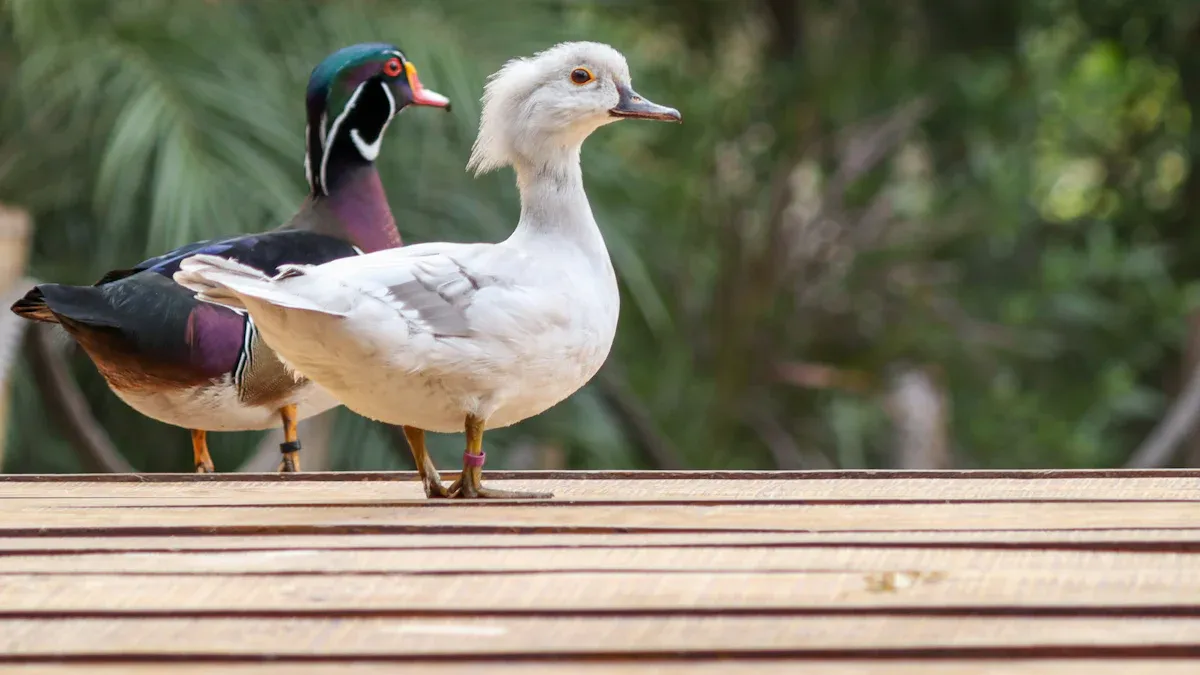
Both Wood Ducks and Mandarin Ducks captivate observers with their stunning beauty. The Wood Duck features intricate facial patterns and a unique crest. The Mandarin Duck, however, showcases prominent orange “sails” and bold head feathers. Male Mandarin ducks display more dramatic and colorful plumage compared to wood ducks. Understanding the specific features of each mandarin duck makes identification a rewarding experience. This detailed guide explores their unique characteristics. It shows how to distinguish these colorful ducks. Wood ducks and mandarin duck are close relatives, making the wood duck vs mandarin duck comparison fascinating.
Key Takeaways
Male Wood Ducks have iridescent green and purple heads with white stripes. Male Mandarin Ducks have orange ‘sails’ on their wings and bold head feathers.
Wood Ducks live in North American forested wetlands. Mandarin Ducks are from East Asia and prefer wooded areas near water.
Both ducks nest in tree hollows. They both like wetlands with trees.
Mandarin Ducks symbolize love and loyalty in Asian cultures. Their images bring good luck.
Wood Duck populations are stable. Mandarin Ducks are not endangered, but their numbers are slowly decreasing.
The Wood Duck: North America’s Jewel
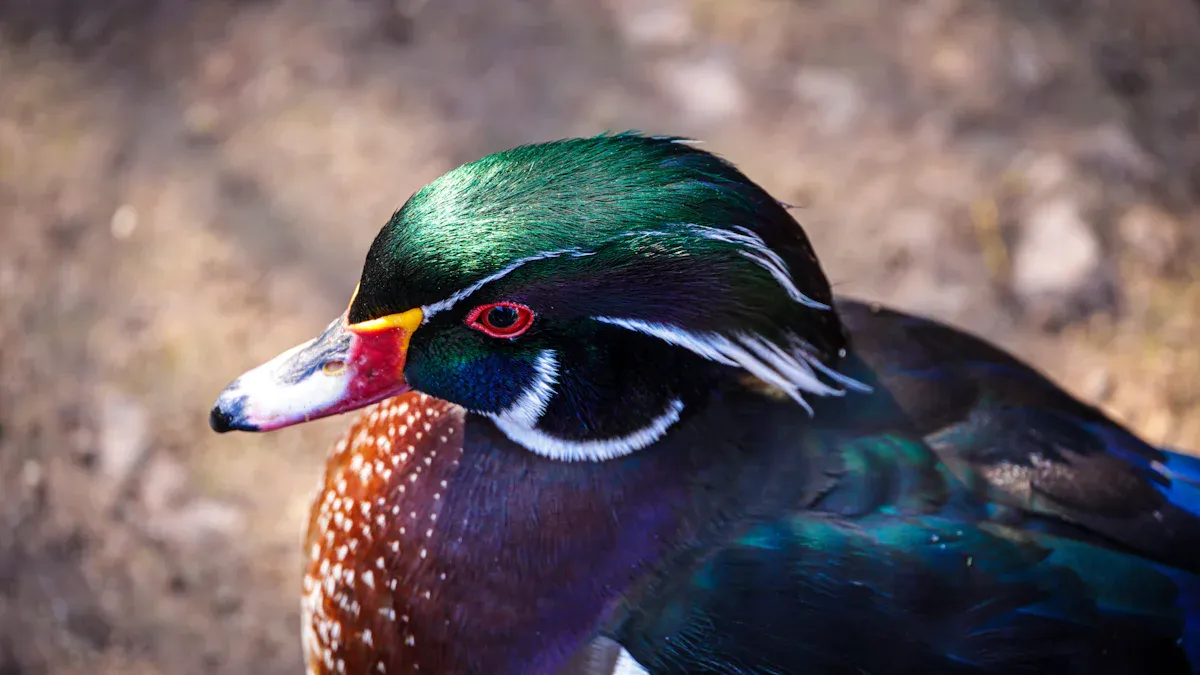
The Wood Duck stands as a true gem among North American waterfowl. Its vibrant appearance makes it easily recognizable.
Male Wood Duck Plumage
Male Wood Ducks display spectacular coloration. Their heads and crests shimmer with iridescent green and purple. A white stripe extends from the eye to the end of the crest. Another narrower white stripe runs from the bill’s base to the crest’s tip. Their breasts are a rich burgundy with white flecks. The flanks show yellow to gold hues with fine, irregular black lines. These striking plumage traits are a prime example of sexual dimorphism, where males are far more colorful than females.
Female Wood Duck Plumage
Female Wood Ducks exhibit more subdued colors, providing camouflage during nesting. Their bodies are generally grayish-brown. A prominent white teardrop shape around the eye is a key identification feature. Their heads are grayer and slightly crested. The breast is speckled with white. Females are considerably duller than males, further illustrating sexual dimorphism in this species of ducks.
Habitat and Range
Wood Ducks thrive in forested wetland complexes. They prefer wooded swamps, ponds, and rivers. These areas often feature a mix of live forest, oxbows, and beaver ponds. They are found across North America. Many populations migrate, but some non-migratory groups exist in southern regions. Wood Ducks are uniquely adapted to breed in deciduous forest biomes, even within urban settings.
Behavior and Diet
Wood Ducks are cavity nesters. They seek natural hollows in trees or use artificial nest boxes. These sites are often near wetlands, crucial during the breeding season. Their diet is diverse. They consume acorns from various oak species, especially in fall and winter. Other plant-based foods include seeds from bald cypress and maples. They also eat insects, flies, and beetles. This duck behaviour helps them adapt to changing food availability.
The Mandarin Duck: An Asian Icon
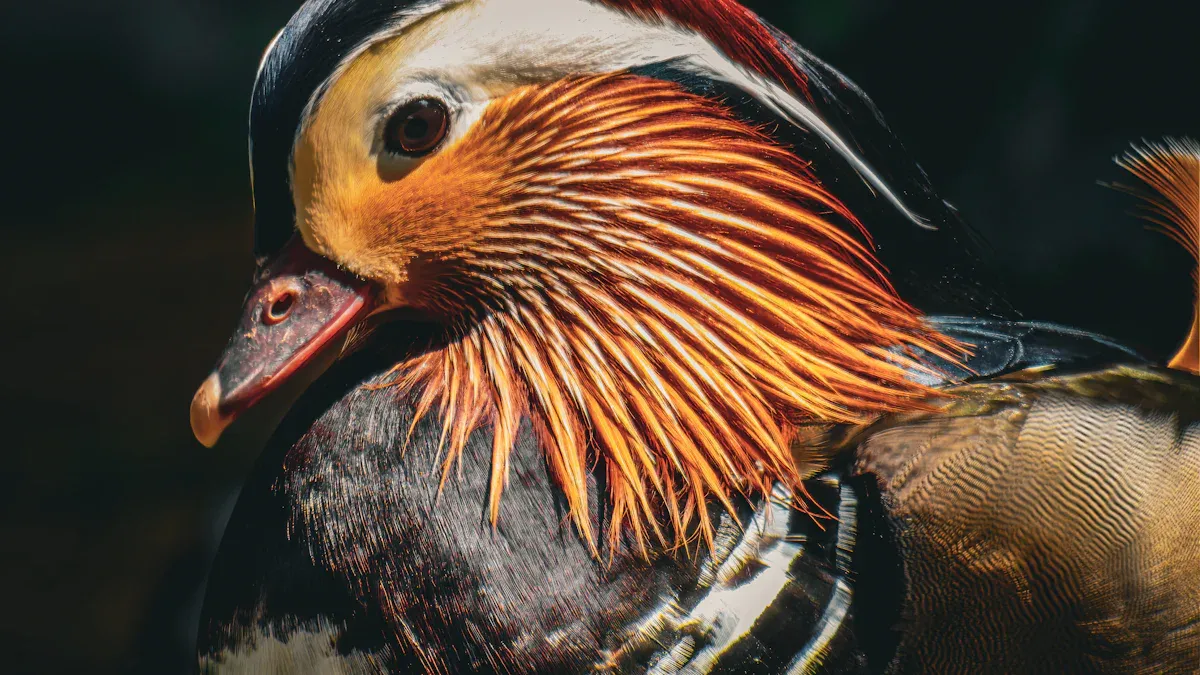
The mandarin duck, a captivating species, originates from East Asia. This mandarin duck showcases an extraordinary array of colors and patterns. The mandarin duck is truly an iconic bird.
Male Mandarin Duck Plumage
Male mandarin duck plumage is remarkably striking. They feature russet-orange wingtips, often called ‘sails’. Their heads boast iridescent green and purple crests at the back, with white streaks. The face is reddish, with a white stripe running along the eyes. A white crescent also marks the face. The breast is iridescent purple-green with white borders. Golden-orange feathers adorn their flanks. These vibrant color blocks and elaborate feather patterns give the male mandarin duck an exotic and bright appearance. This dramatic difference in appearance between males and females is a clear example of sexual dimorphism.
Female Mandarin Duck Plumage
Female mandarin ducks exhibit more subdued colors. Their heads are gray. A distinctive white stripe runs across the eye, creating a ‘reverse doe-eye’ look. They have a slender white eye-ring and a stripe extending back from the eye. Their bodies are brown-grey, with brown backs and mottled flanks. They also have a spotted white and brown breast and white undersides. A small blue-green stripe appears on their flank. Female mandarin ducks are considerably duller than males, further highlighting sexual dimorphism.
Habitat and Range
Mandarin ducks are native to East Asia. Their range includes countries like China, Japan, Korea, and parts of Russia. They inhabit wooded wetlands, including rivers, lakes, and ponds surrounded by forests. They prefer wooded habitats near water bodies. These areas often feature dense vegetation, including broadleaf and mixed forests. As cavity nesters, mandarin ducks prefer nesting in tree hollows near water.
Behavior and Symbolism
Mandarin ducks display interesting duck behaviour. They have a wide range of food sources. They eat plants, insects, snails, and small fish. Occasionally, they consume frogs, worms, and small snakes. Culturally, the mandarin duck holds deep significance in Asian traditions. In China, the mandarin duck symbolizes love, fidelity, and marital bliss. Chinese folklore suggests they form lifelong pairs. Their images often appear in traditional art. In Japan, the mandarin duck represents love and soulmates. Seeing a pair of mandarin ducks together brings good luck.
Wood Duck Vs Mandarin Duck: Visual Comparison
Distinguishing between the Wood Duck and the mandarin duck becomes easier with a direct visual comparison. Both species boast incredible beauty. However, they present distinct features. This section highlights their key differences.
Head and Face Differences
Male Wood Ducks display an iridescent green and purple head. White lines intricately trace their faces. A prominent white stripe extends from the eye. Another white line runs from the bill’s base. Their eyes are a striking red. Both species possess fancy crests they can raise. The male mandarin duck, in contrast, features bold color blocks. Its head shows green and copper hues. A distinct white crescent marks its face. A white stripe also runs across its eye. Female Wood Ducks have a prominent white eye-ring. This creates a clear “eyeliner” effect. Female mandarin ducks show a less dramatic white line around their eyes. This line extends back from the eye. These facial patterns are crucial for telling the wood duck vs mandarin duck apart.
Body Plumage Comparison
The body plumage offers significant differences. The male Wood Duck has a rich chestnut brown breast. This breast is adorned with white flecks. Its flanks show yellow to gold hues. Fine, irregular black lines mark these flanks. The male mandarin duck presents a different picture. It features a rich purple breast. Two vertical white bars stand out on this breast. Its flanks are a vibrant ruddy color. Two sail-like orange feathers are located at the back. These are often called ‘sails’. The male mandarin duck in full plumage possesses a pair of “sail” feathers. These feathers are raised vertically above the back. The Wood Duck lacks these ‘sails’. This absence is a key distinction. The mandarin duck’s more vibrant colors and elaborate feather patterns make it visually distinct. These striking differences between the males of both ducks clearly illustrate sexual dimorphism.
Duckling Distinctions
Even ducklings show differences. Wood ducklings often have an olive-green tint to their faces. Mandarin ducklings, however, typically display a yellow or gold tint to their faces. These subtle color variations help identify the young birds.
Size and Shape
The overall size and body structure also vary. An adult Wood Duck measures 47 to 54 cm (19 to 21 in) in length. Its wingspan ranges from 66 to 73 cm (26 to 29 in). Their weight typically falls between 454 and 862 grams (16.0 and 30.4 oz). The mandarin duck is generally slightly smaller. A typical mandarin duck has a length between 41 and 49 cm. Its wingspan ranges from 65 to 75 cm. Their weight usually falls between 400 and 700 grams. This size difference helps distinguish the wood duck vs mandarin duck.
Beyond Visuals: Lifestyle and Conservation
Shared Traits
Both the Wood Duck and the mandarin duck share several key characteristics. They both nest in tree cavities. They also prefer wooded aquatic environments. These beautiful ducks are close relatives.
Behavioral Nuances
Beyond their striking appearances, these species exhibit distinct behavioral nuances. A female mandarin duck’s call is sudden and explosive. It resembles a whistled sneeze or cough. Male mandarin duck calls include sharp, rising whistles. They also have a lower, snorting, nasal component, often rendered as “hwick” or “uib uib”. Female mandarin duck calls include a loud, sharp, single-noted “kett” or “ke”. They also use a repeated, plaintive “ack” call, known as the “Coquette call,” when displaying. This duck behaviour differs from Wood Ducks. Wood Ducks are serially monogamous.
Males stay with one female for a single breeding season. Males use their colorful plumage to attract females. Females use a loud call. Courtship displays include the ‘wing-and-tail-flash’ and ‘mutual preening.’ Mandarin ducks are social animals. They form large flocks outside the breeding season. They pair up during breeding. Females initiate courtship with displays like shaking and mock drinking. Males attract females with their bright colors. Mandarin duck pairs form strong seasonal bonds. They may breed for several seasons. Males are highly protective of their partners, especially during the breeding season. This mandarin duck behaviour highlights their unique social structures.
Conservation Status
The conservation status of these wild ducks varies. The Wood Duck population once faced near extinction. It is now stable or increasing across North America. The Migratory Bird Treaty Act of 1918 was crucial for their recovery. This act prohibited hunting of wood ducks. Historically, habitat destruction and market hunting caused significant declines. The Atlantic Flyway population is about 1 million birds. The Mississippi Flyway population increases annually.
The IUCN Red List classifies the mandarin duck as a species of ‘Least Concern’. This classification means conservationists are not currently worried about the species’ continuation. A 2006 report estimated a mandarin duck population of 65,000 – 66,000 individuals. The trend is decreasing, but slowly. This slow rate avoids reclassification as ‘Near Threatened’ for the mandarin duck.
Both the Wood Duck and the mandarin duck display captivating beauty. Readers can now confidently identify each species. Their elaborate male plumages, subtle female features, and even duckling coloration provide clear distinctions. The striking features of the mandarin duck are unforgettable. Understanding the wood duck vs mandarin duck differences brings joy. Observing these magnificent birds enriches our lives. The unique charm of the mandarin duck is special. We must appreciate and protect these colorful ducks. The habitats of the mandarin duck need safeguarding. Every mandarin duck deserves a safe home. The mandarin duck is a true marvel.
FAQ
What is the main visual difference between a Wood Duck and a mandarin duck?
The male Wood Duck has intricate facial patterns and a unique crest. The male mandarin duck features prominent orange “sails” on its wings and bold head feathers. The mandarin duck also displays more vibrant color blocks.
Where do mandarin ducks typically live?
Mandarin ducks are native to East Asia. They inhabit wooded wetlands in countries like China, Japan, and Korea. They prefer dense vegetation near water bodies.
Do Wood Ducks and mandarin ducks share nesting habits?
Yes, both species are cavity nesters. They seek natural hollows in trees, often near water. This shared behavior is a common trait for both the Wood Duck and the mandarin duck.
What cultural significance does the mandarin duck hold?
The mandarin duck symbolizes love, fidelity, and marital bliss in Asian cultures. People often see the mandarin duck as a good luck charm for relationships.
Is the mandarin duck an endangered species?
No, the mandarin duck is classified as ‘Least Concern’ by the IUCN Red List. Its population is decreasing slowly, but it is not currently considered threatened.
