


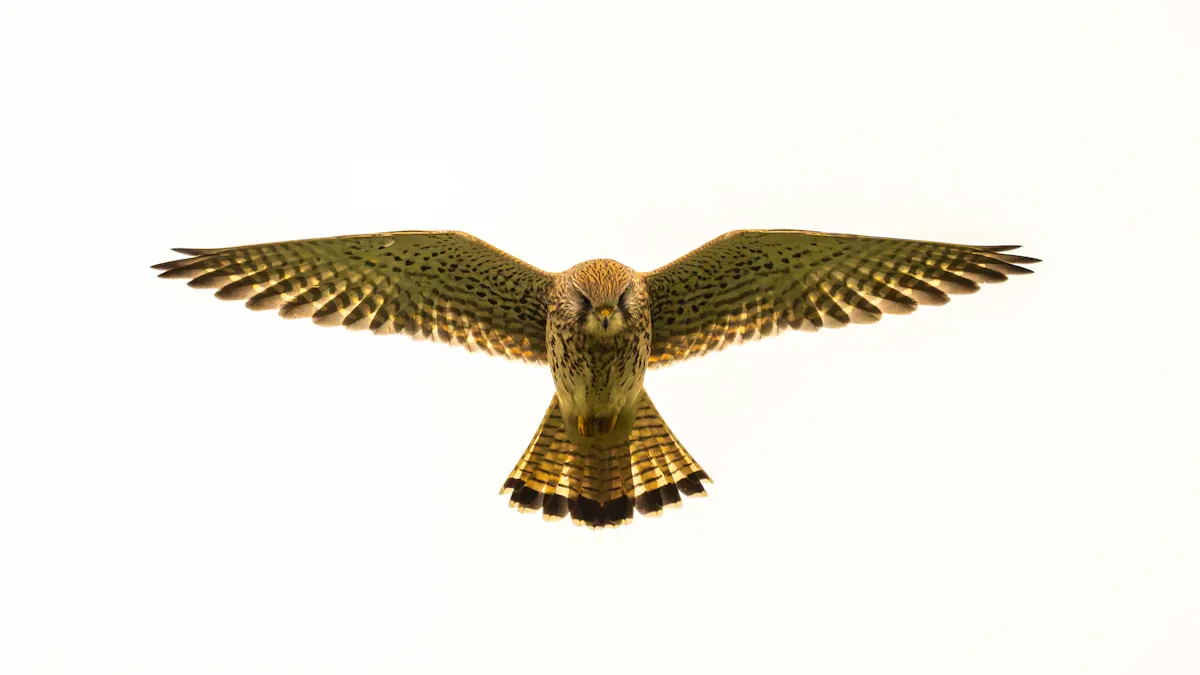
Spotting a hawk in the wild offers a true thrill. You feel a rush seeing these magnificent hawks. Yet, hawk identification can feel daunting. Identifying hawks, especially in flight, presents a real challenge. You might find relying only on plumage misleading for accurate bird identification. Many birdwatching enthusiasts also lack the experience for proper bird identification.
This hawk identification chart simplifies the process for you. It serves as a practical, quick-reference guide. This guide will equip you with the knowledge for quick hawk identification. You will learn to distinguish 12 common hawk types easily, enhancing your birdwatching experience.
Key Takeaways
Look at a hawk’s shape and size. This helps you tell different types apart. Hawks have rounded wings, unlike eagles.
Watch how a hawk flies. Its flight pattern and wing shape give important clues. Some hawks flap quickly, others soar in circles.
Notice the hawk’s feathers and markings. Unique patterns, like a red tail or belly-band, help you identify them.
Consider where you see the hawk. Different hawks live in different places. Their habitat and behavior can help you know what kind it is.
Hawk Identification Basics
You can quickly identify hawks by observing a few key features. This section provides fundamental tips for quick hawk identification. Understanding hawks starts with these basics.
Hawk Silhouettes and Size
Look at a hawk’s overall shape. This is often your first clue. Hawks typically have rounded wings. This distinguishes them from eagles, which have more rectangular, boxy wings. Size also matters. You can estimate a hawk’s size by comparing it to familiar birds like crows or ravens. Here is a quick reference for common hawk wingspans:
Hawk Species | Wingspan Range/Up To |
|---|---|
Red-tailed Hawk | 3′ 7″ to 4′ 7″ |
Sharp-shinned Hawk | Up to 2′ 3″ |
Cooper’s Hawk | Up to 3′ |
Red-shouldered Hawk | Up to 3′ 6″ |
Broad-winged Hawk | Up to 2′ 9″ |
Ferruginous Hawk | Up to 4′ 8″ |
You can also visualize these sizes with a chart:
Deciphering Flight Patterns and Wing Shape
Observe how a hawk flies. Its flight pattern and wing shape offer vital clues for bird identification. Accipiters, like Cooper’s Hawks, have rounded wings and long tails. They fly with quick wingbeats and glides. Buteos, such as Red-tailed Hawks, have broad wings. They often soar in wide circles on thermals. This table helps you distinguish flight styles:
Feature | Accipiters | Buteos |
|---|---|---|
Wing Shape | Rounded or slightly pointed | Notably straight and broad |
Tail Shape | Longer and more rounded | Relatively short and stout |
Flight Style | Quick movements through trees | Soaring on thermals, sluggish |
Key Plumage and Markings to Observe
Plumage refers to a bird’s feathers. Specific markings on feathers are keys to id. Look for unique patterns. For example, the Red-tailed Hawk has a distinct red tail as an adult. Many hawks also have a “belly-band” of streaks. The Rough-legged Hawk shows a broad oval blackish wrist patch. These details are crucial for accurate hawk identification.
Habitat and Behavior Clues
Where you find a hawk and what it does can help your identification. Red-tailed Hawks, for instance, prefer open country. You often see them perched on roadside poles. They also soar over fields. Other hawks, like the Northern Harrier, hunt low over marshes. This hawk identification chart focuses on common types. Knowing their preferred habitats and typical behaviors greatly assists your bird identification efforts.
12 Key Hawk Types for Quick Identification
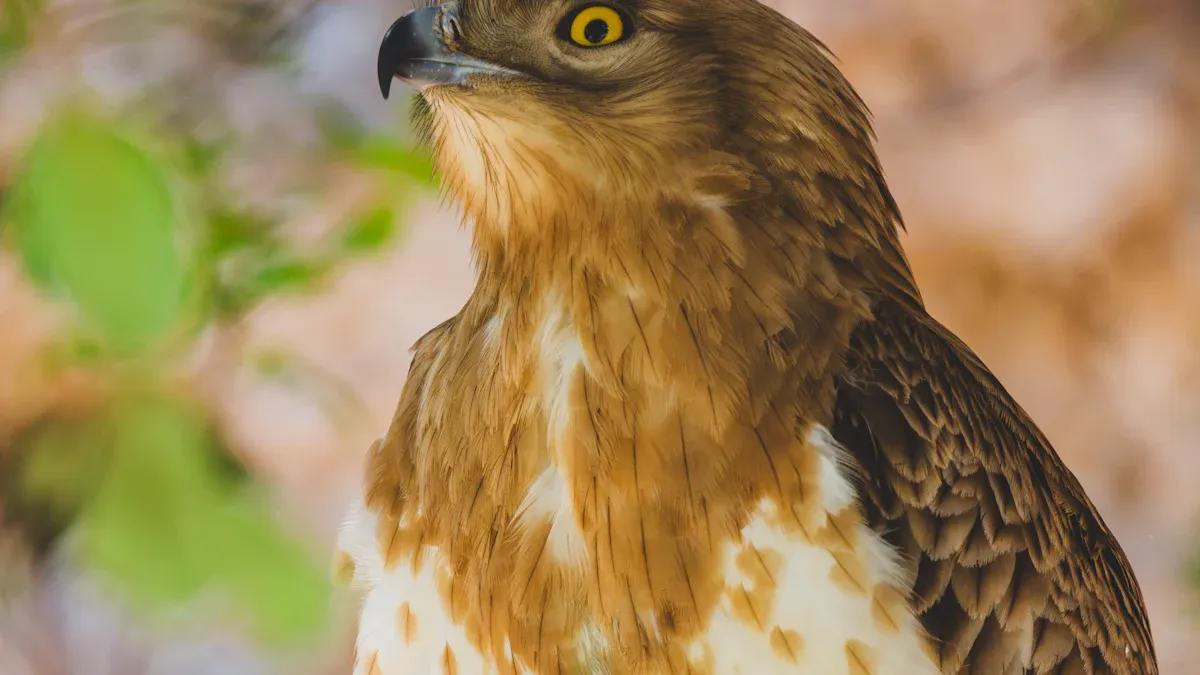
This hawk identification chart helps you quickly recognize common species. You will learn specific markers for each hawk type. This section is crucial for your birdwatching journey.
Red-tailed Hawk: Common Sightings
You often see Red-tailed Hawks. They are one of North America’s largest Buteo members. These hawks typically weigh from 1.5 to 3.5 pounds. They measure 18–26 inches in length. Their wingspan ranges from 43–57 inches. Females are about 25% heavier than males.
Red-tailed Hawks show variable plumage. Their basic appearance is consistent: a blocky, broad shape. They often appear heavier than other Buteos of similar length. Most color variations feature a whitish underbelly. A dark brown band forms from horizontal streaks. Younger birds may have dark brown spotting on their underside. The namesake red tail is uniformly brick-red above. It appears light buff-orange below. Adults are easy to identify by their red tail ending in a single black band. Immature birds have a tail patterned with about six darker bars. You will notice their short, dark, hooked bill. Their head can look small compared to their thick body. They have relatively short, broad tails and thick, chunky wings. Their cere, legs, and feet are yellow. Immature birds have yellowish irises. These darken to reddish-brown over 3-4 years as they mature.
Red-tailed Hawks are partial migrants. Those breeding in Canada, Alaska, and the northern Great Plains move south for winter. Hawks in the Lower 48 states often stay year-round. Their numbers increase in many parts of the country during winter. You will find significant plumage variability in these hawks. Some have dark belly markings, others less. Some are nearly all white underneath. The ‘Krider’s’ race can be almost all white, including the head. It lacks the dark reddish tail. The ‘Harlan’s’ race is a dark bird, almost entirely dark brown.
Red-shouldered Hawk: Woodland Hunter
Red-shouldered Hawks are medium-sized birds. They have broad, rounded wings and medium-length tails. They fan their tails while soaring. In flight, they show a distinctive ‘reaching’ posture. They glide or soar with their wingtips pushed slightly forward.
Adults are colorful. They feature dark-and-white checkered wings. You will see warm reddish barring on their breast. They have a black tail marked by narrow white bands. Immature birds are brown above. They are streaked brown and white below. All ages display narrow, pale crescents near their wingtips during flight. When perched, especially in the eastern United States, you will often see them leaning forward.
These hawks prefer to hunt from perches within the forest understory. They also fly low through the forest. They use stealthy surprise attacks to pounce on prey. Their diet mainly includes aquatic and semi-aquatic animals. These are frogs, small fish, snakes, and crayfish. They also eat lizards, rodents, smaller birds, and large insects. You find them in deciduous woodlands, often near rivers and swamps. They also inhabit bottomland forests, swamps, open upland forests, and wooded suburbs. During migration, they move high overhead along ridges or coasts.
Broad-winged Hawk: Migratory Patterns
Broad-winged Hawks are smaller Buteos. They measure 13.4-17.3 inches (34-44 cm) in length. You can identify adults by their broad black and white tail bands. Juveniles have narrowly banded tails. Adult light-morphs show strongly banded black and white tails. The white bands are thinner. Adult dark-morphs have a broad white band in their tail.
Look at their wing patterns. Adults have pale undersides bordered in dark brown. They show a dark outline to the trailing edge of their wings. Juveniles lack a blackish border on the back edge of their wings. Their primaries show a faint, rectangular translucence from below. You might also notice dark wing linings and crescent-shaped ‘windows’ near their wingtips.
Cooper’s Hawk: Backyard Predator
Cooper’s Hawks are medium-sized. They have a classic accipiter shape. You will see broad, rounded wings and a very long, rounded tail. Their head often appears large. Their shoulders look broad. They are crow-sized. Males can be much smaller. Adult Cooper’s Hawks have steely blue-gray upperparts. They show warm reddish bars on their underparts. Thick dark bands mark their tail. Juveniles are brown above. They have crisp brown streaking on their upper breast. This gives them a somewhat hooded appearance.
When identifying a Cooper’s Hawk, pay attention to eye color. Juvenile Cooper’s Hawks typically have bright yellow eyes. This differs from the orange eyes of juvenile Sharp-shinned Hawks. However, some overlap can occur, with dull yellow or orangish eyes in both. This hawk is a common backyard predator. You might see a Cooper’s Hawk hunting smaller birds. A Cooper’s Hawk often surprises its prey. The Cooper’s Hawk is a skilled hunter. You can often spot a Cooper’s Hawk in suburban areas. The Cooper’s Hawk is a fascinating bird. This Cooper’s Hawk is a true marvel.
Sharp-shinned Hawk: Small Accipiter
Sharp-shinned Hawks are small raptors. They have thin legs and small feet. Their wings are short and rounded. They often push their wings forward in flight. They have a long, square-tipped tail. This tail may have a notch at the tip. Their head is small. In flight, it may not project beyond the ‘wrists’ of their wings. Adults have blue-gray upperparts. They show narrow, horizontal red-orange bars on their breast. Immature birds are brown above. They have thick brown streaks below. Coarse vertical streaks mark their white underparts. Both adults and young have broad dark bands across their long tails.
These hawks have a distinctive flight style. They use a few quick wingbeats followed by a short glide. This is called a flap-and-glide. They are agile fliers. They speed through dense woods. They can appear unsteady in flight in windy conditions due to their small size. Females are much larger than males. They are one-third larger. Males are about the size of an American Kestrel. They are slightly larger than a jay. Females approach the size of a male Cooper’s Hawk.
Northern Goshawk: Forest Dweller
The Northern Goshawk is a powerful forest dweller. It is the largest accipiter in North America. You will notice its broad, rounded wings and long tail. Adults have dark slate-gray upperparts. Their underparts are finely barred gray and white. They have a distinctive dark cap and a prominent white eyebrow stripe. Juveniles are brown above with streaked underparts. This hawk is a fierce hunter of birds and mammals in dense forests. Its flight is fast and direct.
Swainson’s Hawk: Open Country
Swainson’s Hawks are large hawks. They have broad wings and short tails. They appear slimmer and longer-winged than many other Buteos. When soaring, they often hold their wings in a shallow V shape. This is similar to a Northern Harrier or Turkey Vulture. They measure 18.9-22.1 inches (48-56 cm) in length. They weigh 24.4-48.2 oz (693-1367 g). Their underwings are distinctive. They have white wing linings that strongly contrast with blackish flight feathers. Most males have gray heads. Females tend to have brown heads.
Swainson’s Hawks show highly variable plumage. They have a complete continuum from light to dark. Most are light-bellied with a dark or reddish-brown chest. Their upperparts are brown or gray. Light morph adults typically have a brown head and breast with an unmarked white belly. They have a distinctive brown upper vest, creating a hooded appearance. Dark flight feathers form a dark trailing edge to the wing.
Dark morph adults can range from reddish to nearly all black. They show reduced contrast on their underwings. They are usually dark brown with rufous underwing coverts and light undertail coverts. Darker-plumaged birds are more common in the West. Nearly all Swainson’s Hawks breeding east of the Rocky Mountains are light in appearance. These hawks prefer open country and grasslands. They are typical nesting Buteos of grasslands. They also use sage flats, croplands, pastures, hayfields, and agricultural areas.
Rough-legged Hawk: Winter Visitor
Rough-legged Hawks are large Buteos. Females are larger than males. They appear delicate despite their size. They have small feet and a small bill. This is an adaptation for cold weather. You often see them hovering or kiting over agricultural areas or grasslands. They face into the wind to stay aloft. Their head remains fixed while their body and tail adjust. They perch on utility poles, fence posts, trees, or even the ground. Sometimes they perch on the smallest twigs at the very top of trees. In flight, their wings are long and somewhat narrow. Their tail is relatively long. They exhibit buoyant and languid flight. They soar with a dihedral and slight teetering. They can hover and kite for extended periods. Their wing beats are described as ‘floppy’ but powerful.
These hawks have both light and dark morphs. Light morphs have pale underwings with dark patches at the wing’s bend. Females of this morph have pale heads and dark belly patches. Males show a similar but more mottled pattern. Dark morphs are mostly dark brown. They typically display pale trailing edges on their underwings.
The name ‘Rough-legged’ Hawk refers to the feathering that extends down their legs all the way to their toes. This is a distinguishing feature. Only the Ferruginous Hawk and the Golden Eagle share this among American raptors. It helps them stay warm in frigid weather. This hawk is unique among soaring Buteo hawks for its tie to cold climates. It nests in the Arctic, primarily in tundra regions. In winter, only a few migrate farther south than the central United States. Their winter habitats include open fields, plains, marshes, grasslands, coastal prairies, farmland, and dunes.
Ferruginous Hawk: Western Prairies
Ferruginous Hawks are large Buteo hawks. They are larger than a Swainson’s Hawk but smaller than a Golden Eagle. They typically measure 22.1-27.2 inches in length. They weigh 34.5-73.2 ounces. Their wingspan is 52.4-55.9 inches.
Key identification features include their relatively long wings with more pointed tips than other Buteos. They also have large heads. Light-morph individuals are striking. They have white underparts, rusty legs that form a V in flight, rusty upperparts, and pale heads. Dark-morphs are a deep rufous-chocolate. They have white bases to primary feathers, forming white panels. They soar with wings slightly raised but wingtips almost flat. They can hover or kite while hunting.
Perched birds have a white breast and body with dark legs. Their back and wings are brownish-rust. Their head is white with a dark streak behind the eye. In flight, their underside is light with dark legs forming a ‘V’ shape. Reddish upper-back color extends to the inner wing-coverts. They have dark gray primary remiges with conspicuous light ‘windows’ in the inner primaries. You will see three prominent light areas on their upper surface. This includes a rufous rump mark.
Their wings are noticeably longer and appear slenderer than a Red-tailed Hawk’s. They have dark ‘comma’-shaped markings at their wrists. They are one of only two hawks with feathered legs down to their toes. Their preferred habitat includes arid and semi-arid grassland regions of North America. They like open, level, or rolling prairies, foothills, or middle elevation plateaus largely devoid of trees. They also use cultivated shelterbelts or riparian corridors.
Harris’s Hawk: Unique Social Behavior
Harris’s Hawks are large, lanky raptors. They have long legs and fairly long tails. Their wings are broad and rounded. Females are nearly twice the weight of males. They are dark brown overall. They have reddish-brown feathers on their wings and thighs. Their tail is mostly dark with a white rump and a white terminal band. Their inner wings are reddish-brown from below. Immature birds have white patches on their belly and wings. They have a narrower white tail band. Fine barring marks their underwings and tail. You will notice their bold markings of dark brown, chestnut red, and white. They have long yellow legs and yellow markings on their face.
These hawks are the most social of North American raptors. They cooperate at nests and hunt as a team. Hunting groups surround prey. They flush it for another to catch, or take turns chasing it. Cooperatively hunting groups are more successful at capturing prey than individuals. Hawks in groups of more than two members have higher survival rates. They breed in social units. These range from an adult pair to as many as seven individuals.
This includes both adults and subadults. Groups show monogamy, polyandry, and sometimes polygyny. They use sophisticated cooperative hunting strategies. These include leap-frogging to chase prey. They converge from multiple directions to cut off escape. They also surround hidden prey while one bird flushes it. You will see them perch upright on telephone poles, cactus, posts, or other elevated features. They hunt and travel in groups. Sometimes they walk or run along the ground when hunting. They soar on rounded wings, frequently fanning their tails.
Osprey: Fish Hunter
Ospreys are easily identified. They have dark brown upperparts and white underparts. Variable gray-brown spots and streaks mark their breast. Their heads are primarily white with dark brown eye stripes. Juveniles have cream-white edges on their dark brown feathers. They have orange eyes, which turn yellow in adults. They are medium-sized raptors. They are smaller than a bald eagle but similar in size to a turkey vulture. They measure 21.6 to 23 inches in length. Their wingspan is 57 to 67 inches. They weigh 2.1 to 4.5 pounds depending on sex. Other field marks include bushy feathers on their nape. They have long, narrow arched wings. These form an ‘M’ shape in flight. Their tail is dark gray with a lighter bar. Their beak is mostly black with a bluish cere and base. Their legs and feet are pale with a faint blue tinge.
The Osprey is the only raptor that plunge-dives feet first to catch live fish. This is its main prey source. It accesses only about the top meter of water. This restricts its foraging to surface-schooling fish and those in shallow waters. This specialized technique involves using its talons to capture fish near the water’s surface. While primarily fish-eating, Ospreys sometimes eat other foods. These include birds, snakes, voles, squirrels, muskrats, salamanders, conchs, and small alligators. They have also been seen feeding on carrion like dead white-tailed deer and opossum.
Northern Harrier: Marsh Hunter
Northern Harriers are recognized by their low flight over the ground. They weave back and forth across fields and marshes while hunting. Their low, buoyant flight style is a key identifier. It is similar to a Short-eared Owl’s. While hunting, this raptor slowly flaps and glides just above the ground. It holds its wings in a shallow V (dihedral). This hawk is also known as the marsh hawk. It is unique for its owl-like facial disc. This aids in hunting by sound. It frequents open spaces like fresh and saltwater marshes, farmland, meadows, tundra, prairie, and grasslands. It prefers low vegetation. Its distinctive hunting style involves coursing. It zigzags slowly across open areas, using its hearing.
The harrier’s slender build, long wings, legs, and tail contribute to a moth-like buoyancy. This allows it to fly slowly without stalling. It typically courses 10 to 30 feet above ground. It uses slow, deep, regular wingbeats. These are interspersed with short, sailing glides. Wings are held in a bold V-shape (dihedral) during glides. This slow, tilting flight enables it to drop instantly onto prey. You will find them in agricultural lands, grasslands, and marshes.
Other hawk species, such as the Common Black-Hawk, Gray Hawk, Short-tailed Hawk, White-tailed Hawk, and Zone-tailed Hawk, are found in southern states and Mexico. This hawk identification chart focuses on these 12 key types.
Differentiating Hawks from Other Raptors
You might confuse hawks with other birds of prey. This section helps you distinguish hawks from similar raptors. You will learn key differences in their appearance and behavior.
Hawks Versus Falcons: Speed and Build
Falcons are built for speed. They have pointed, sleek wings. Their flight is fast and powerful. A Merlin, for example, is crow-sized. It has a classic falcon shape. You will see quick, powerful wingbeats. Merlins are 9-12 inches long. They have a banded gray tail. Hawks, in contrast, often have broader, more rounded wings. They use a mix of soaring and flapping.
Hawks Versus Eagles: Size and Head Shape
Eagles are generally larger than hawks. Most eagles you encounter will be bigger than hawks. For instance, North American hawks typically measure 18-26 inches in length. Eagles, like Bald Eagles, can be 28-40 inches long. Their wingspan is also much greater. Bald Eagles have an approximate 80-inch wingspan, while hawks average 45-52 inches.
Feature | Eagles | Hawks |
|---|---|---|
Size (Length) | 28 – 40 inches (e.g., Bald Eagles) | 18 – 26 inches (North American hawks) |
Wingspan | Approximately 80 inches (e.g., Bald Eagles), 6-8 feet | 45 – 52 inches (average), 3-4 feet |
Weight | 6.6 – 14 pounds (e.g., Bald Eagles), Golden Eagle is largest | 1.5 – 3.5 pounds |
Beak | Large, hooked, capable of breaking bones | Smaller, curved, suited for softer prey |
An eagle’s head and bill appear sturdier and heavier than a hawk’s. A Red-tailed Hawk’s bill is shorter and more bluntly hooked than a Golden Eagle’s. Its head also looks proportionally smaller.
Hawks Versus Vultures: Flight and Diet
Vultures have a distinct flight pattern. They soar with slow flapping. Their wings are broader and more rounded. Hawks, however, show swift, agile flight. They have more pointed, streamlined wings. A major difference lies in their diet. Vultures feed exclusively on carrion, which means dead animals. Hawks hunt live prey. They eat small mammals, birds, and reptiles.
Feature | Hooded Vulture | Hawk |
|---|---|---|
Flight Pattern | Soaring with slow flapping, broader rounded wings | Swift agile flight, pointed streamlined wings |
Diet | Carrion (dead animals) | Small mammals, birds, and reptiles |
Differentiating hawks from these other raptors helps you make accurate identifications.
You will find immense satisfaction identifying hawks in their natural habitat. Use this hawk identification chart as your essential starting point for exciting birdwatching adventures. Remember, practice and keen observation are key to becoming truly proficient in bird identification.
Tip: Join local birdwatching groups! Sharing knowledge helps you learn faster.
Continue your learning journey and engage with the vibrant birdwatching community. Now, go outside and start spotting these magnificent hawks. You can do it!