


You’ll want gentle, low‑stress filtration that still handles high waste: for large tanks pick the Coospider‑Repta internal filter (55–150 gal) or the 3‑stage internal (40–70 gal) for extra media and circulation; mid‑size tanks do well with the Fluval 50 (20–50 gal); small setups or juveniles are best with the Pawfly 80 GPH internal or the AQQA sponge corner filter for ultra‑gentle flow. Keep flow adjustable, use sponge covers, and follow regular maintenance — keep going to see specifics and setup tips.
| Aquarium Internal Filter for 55–150 Gallon Tanks |

| Best for Large Tanks | Recommended Tank Size / Capacity: 55–150 gallons (large tanks, ponds, turtle/koi use) | Filtration Types / Media: Dual-stage black biochemical sponge (mechanical + biological/odor removal) | Submersible / Internal Design: Internal submersible filter (detachable body) | VIEW LATEST PRICE | Read Our Analysis |
| AQQA Sponge Corner Aquarium Filter for Small Tanks |
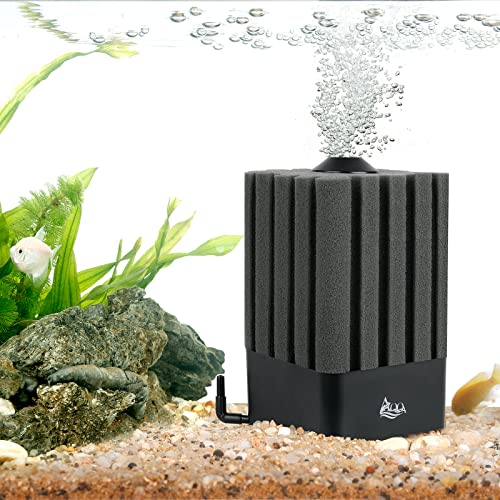
| Best for Fry & Shrimp | Recommended Tank Size / Capacity: 5–20 gallons (small tanks; also available in medium variant) | Filtration Types / Media: Sponge (mechanical) + bio ceramic balls (biological) | Submersible / Internal Design: Submersible sponge filter (corner-style; air-powered) | VIEW LATEST PRICE | Read Our Analysis |
| Fluval 50 Power Aquarium Filter for 20–50 Gallons |

| Best Quiet Performer | Recommended Tank Size / Capacity: 20–50 gallons | Filtration Types / Media: Mechanical + chemical + biological (foam, activated carbon, BioMax, Cycle Guard) | Submersible / Internal Design: Internal/power hang-on or internal power filter (packaging varies; designed for in-tank use) | VIEW LATEST PRICE | Read Our Analysis |
| 3-Stage Internal Aquarium Filter for 40–70 Gallons |

| Best Multi-Stage Cleaner | Recommended Tank Size / Capacity: 40–70 gallons (recommend possibly using two for very large tanks) | Filtration Types / Media: 3-stage sponge system (coarse sponge, carbonized sponge, fine sponge) | Submersible / Internal Design: Fully submersible internal pump/filter (epoxy-sealed motor) | VIEW LATEST PRICE | Read Our Analysis |
| Pawfly Internal Aquarium Filter with 80 GPH Pump |

| Best for Small Tanks | Recommended Tank Size / Capacity: 10–20 gallons | Filtration Types / Media: Fine sponge mechanical + biological bio-sponge | Submersible / Internal Design: Internal submersible bio sponge filter | VIEW LATEST PRICE | Read Our Analysis |
More Details on Our Top Picks
Aquarium Internal Filter for 55–150 Gallon Tanks
Should you keep large tanks or require a single internal unit that handles heavy bioloads, this Aquarium Filter for 55–150 Gallons (coospider‑repta model 024) is a strong choice — it delivers 300 GPH flow with dual-stage biochemical sponges to control odors and clear water while enhancing circulation and aeration. You’ll install the black submersible easily; its detachable body and removable lower sponge let you fit tanks under 15 inches. The adjustable valve increases oxygen and surface movement, helping axolotls tolerate higher bioloads. At 1.5 pounds with a one-year warranty, it’s built for turtle, koi, and large fish setups.
- Recommended Tank Size / Capacity:55–150 gallons (large tanks, ponds, turtle/koi use)
- Filtration Types / Media:Dual-stage black biochemical sponge (mechanical + biological/odor removal)
- Submersible / Internal Design:Internal submersible filter (detachable body)
- Aeration / Oxygenation:Adjustable valve to increase oxygen (boosts surface movement)
- Flow / Pump Performance:Pump capacity 300 GPH
- Maintenance / Replaceable Media:Detachable body; dual sponge elements (implies replaceable/cleanable); 1-year warranty
- Additional Feature:Adjustable low-profile layout
- Additional Feature:Dual deep biochemical sponge
- Additional Feature:1-year warranty included
AQQA Sponge Corner Aquarium Filter for Small Tanks
In case you keep a small axolotl tank (5–20 gallons) and want gentle, low‑flow filtration with biological support, the AQQA sponge corner filter is a strong choice because its sponge provides mechanical filtration while included ceramic bio‑balls encourage nitrifying bacteria. You’ll install the grey, air‑powered GUS‑AQ046‑S in a corner, squeeze the sponge until it sinks, and connect an external air pump and hose (not included). It offers filtration, aeration, and circulation with ultra‑quiet operation. Two sponges and washable ceramic media come standard, and you can replace media as needed. It’s compact, lightweight, and suited to fry, shrimp, betta, or small axolotl setups.
- Recommended Tank Size / Capacity:5–20 gallons (small tanks; also available in medium variant)
- Filtration Types / Media:Sponge (mechanical) + bio ceramic balls (biological)
- Submersible / Internal Design:Submersible sponge filter (corner-style; air-powered)
- Aeration / Oxygenation:Air-powered design provides aeration (requires external air pump)
- Flow / Pump Performance:Air-driven flow (flow dependent on external air pump; ultra-quiet)
- Maintenance / Replaceable Media:Removable/reusable sponges and washable/replaceable ceramic balls (two sponges included)
- Additional Feature:Air-pump driven operation
- Additional Feature:Included bio-ceramic media
- Additional Feature:Two sponges supplied
Fluval 50 Power Aquarium Filter for 20–50 Gallons
Should you keep a 20–50 gallon axolotl tank and want reliable, all-in-one filtration, the Fluval 50 Power Filter is a strong choice — it combines mechanical, chemical, and biological media (AquaClear foam, activated carbon, BioMax, Cycle Guard) to maintain clear, stable water while running quietly and efficiently. You’ll get filtration volume up to seven times larger than comparable units, giving superior contact time with media and better water quality. The quiet, energy-efficient pump lowers operating costs. Installation is quick and simple, and you should clean the unit every two weeks to preserve peak performance and protect your axolotl’s environment.
- Recommended Tank Size / Capacity:20–50 gallons
- Filtration Types / Media:Mechanical + chemical + biological (foam, activated carbon, BioMax, Cycle Guard)
- Submersible / Internal Design:Internal/power hang-on or internal power filter (packaging varies; designed for in-tank use)
- Aeration / Oxygenation:Designed to improve water circulation and contact time (quiet efficient pump increases oxygenation)
- Flow / Pump Performance:High-efficiency power filter with quiet pump (rated for 20–50 gal; larger media/contact time)
- Maintenance / Replaceable Media:Multi-media cartridges (foam, carbon, BioMax) designed for periodic replacement/cleaning; recommend cleaning every 2 weeks
- Additional Feature:Multi-media included pack
- Additional Feature:High contact-time design
- Additional Feature:Energy-efficient quiet pump
3-Stage Internal Aquarium Filter for 40–70 Gallons
Should you keep axolotls in a 40–70 gallon tank and want reliable mechanical, chemical, and fine filtration in one compact unit, this 3-stage internal filter is a strong choice. You get a max flow of 225 GPH and a 4 ft lift from an 8.2 W epoxy-sealed submersible pump that’s tested under high voltage for safety. The coarse, carbonized, and fine sponges trap debris, remove odor/chlorine, and polish water; sponges are replaceable (code B0CRRFW5ZG). Dual outlets and a venturi enhance circulation and oxygenation. Place units in back-left and back-right corners; use two units when your tank feels under-filtered.
- Recommended Tank Size / Capacity:40–70 gallons (recommend possibly using two for very large tanks)
- Filtration Types / Media:3-stage sponge system (coarse sponge, carbonized sponge, fine sponge)
- Submersible / Internal Design:Fully submersible internal pump/filter (epoxy-sealed motor)
- Aeration / Oxygenation:Built-in air venturi with air tubing to increase oxygenation
- Flow / Pump Performance:Max flow 225 GPH (850 L/h); max lift 4 ft; 8.2 W
- Maintenance / Replaceable Media:Transparent cartridge box for inspection; replaceable sponges (replacement code available)
- Additional Feature:Transparent cartridge box
- Additional Feature:Dual water outlets
- Additional Feature:High-voltage submersion tested
Pawfly Internal Aquarium Filter with 80 GPH Pump
Should you’re keeping axolotl juveniles, shrimp, or fry and want gentle, reliable filtration, the Pawfly Internal Aquarium Filter is a solid pick — its fine sponge traps debris and provides biological filtration without sucking up small animals. You’ll fit it in 10–20 gallon tanks; it’s compact (5.3 x 1.6 x 5.3 in) and light (8.4 oz). The 4 W pump delivers 80 GPH with a slide knob for flow control and two outlet options (drenching or spraying). It includes airline tubing for aeration. Disassemble to clean impeller and remove the sponge; rinse sponge in tank water every two weeks.
- Recommended Tank Size / Capacity:10–20 gallons
- Filtration Types / Media:Fine sponge mechanical + biological bio-sponge
- Submersible / Internal Design:Internal submersible bio sponge filter
- Aeration / Oxygenation:Includes airline tubing; produces bubbles to increase dissolved oxygen
- Flow / Pump Performance:Pump flow 80 GPH; 4 W; adjustable flow slider
- Maintenance / Replaceable Media:Removable sponge and impeller for cleaning; rinse sponge with aquarium water every ~2 weeks
- Additional Feature:Flow control slide knob
- Additional Feature:Two outlet styles
- Additional Feature:Includes airline tubing
Factors to Consider When Choosing Filters For Axolotl Tanks
Upon selecting a filter for your axolotl tank, you’ll want control over flow rate and gentle water movement to keep your pet comfortable. Prioritize efficient biological filtration and low noise/vibration so the tank stays healthy and peaceful. Also consider ease of maintenance and access for quick cleaning and media changes.
Flow Rate Control
Because axolotls prefer gentle currents, you’ll want a filter setup that moves water without creating a strong jet—aim for roughly 2–4 tank volumes per hour for adults and use adjustable outlets, spray bars, or sponge covers to diffuse flow so circulation is soft and evenly distributed at the level they live. Choose filters with flow controls or add valves and directional outlets to lower outlet velocity. Fit sponge pre-filters or intake guards to reduce suction and protect gills. Prioritize biological media and contact time over raw GPH so beneficial bacteria can process waste effectively. Watch your axolotl: in the event that it’s constantly fighting the current or can’t feed, dial flow down. Measure movement where it rests and adjust until behavior shows comfort.
Gentle Water Movement
Often you’ll want the gentlest possible circulation that still prevents dead spots—aim for about 2–4 tank turnovers per hour and spread that flow across multiple low‑power outlets or a sponge filter so the current never becomes a single strong jet. Choose adjustable-flow or low‑power filters and angle outflows toward a wall or upward to the surface to diffuse force. Prefer sponge filters or units with bulky mechanical media to create broad, gentle movement and avoid strong suction near gills or limbs. Use dual low‑flow outlets or soft airstones to produce even circulation without turbulent zones. Watch your axolotl: in the event it struggles, hides near the flow, or constantly sifts substrate, reduce flow immediately to prevent stress or injury.
Biological Filtration Efficiency
Should you want steady water chemistry and healthy gill function, prioritize biological filtration that gives lots of bacterial surface area and can handle at least 1.5–2× your axolotl’s waste load. Choose media with high porosity and internal surface area—coarse sponges, ceramic rings, or bio-balls—so nitrifying bacteria (Nitrosomonas/Nitrospira) establish large colonies and process ammonia → nitrite → nitrate quickly. Rinse media gently in tank water during partial changes; never use tap water or replace all media at once, which can wipe out bacteria and cause toxic spikes. Test ammonia and nitrite daily while cycling and at least weekly afterward; any detectable levels mean your bacterial capacity was exceeded or disturbed. Size biological media conservatively for consistent, reliable biochemical filtration.
Noise And Vibration Levels
Provided your axolotl is going to thrive, pick a filter that minimizes constant low-frequency noise and vibration, since these disturb feeding and encourage hiding. You should favor units with low vibration ratings or quiet brushless motors to reduce stress-related behaviors. Inline or external filters usually transmit less vibration into the water and glass than internal submersibles, so opt for them in case noise is a priority. Look for adjustable flow settings plus rubber or silicone mounting or suction pads to dampen motor vibration and cut transmitted noise. Aim for products labeled “whisper-quiet” or specifying around 30–35 dB at one meter. Finally, keep impellers clean and replace worn parts on schedule—clogged or imbalanced components often cause rattling and increased vibration.
Maintenance And Access
Good access is as essential as filtration power: pick a filter with easily removable lids or cartridge access so you can reach sponges, media, and the impeller without dismantling the whole unit—cleaning should take under 10 minutes. You’ll want a coarse sponge or pre-filter cover you can rinse weekly in dechlorinated tank water to preserve beneficial bacteria. Inspect and clean the impeller and housing every 2–4 weeks, or sooner provided flow drops, to avoid clogging and reduced oxygenation. Replace chemical media like activated carbon about every 3–4 weeks so adsorption stays effective without disturbing biological media. Whenever you service the filter, perform a 10–25% water change and gently squeeze sponges in removed tank water to protect nitrifying colonies.